

Solar PV Yields by Pembrokeshire Postcode
Honest postcode-level yield numbers for Pembrokeshire solar PV — modelled with Aiko Neostar 460 W and JA Solar 470 W modules — so you know what to expect from a 4 kW system in Tenby vs Fishguard before you sign anything.
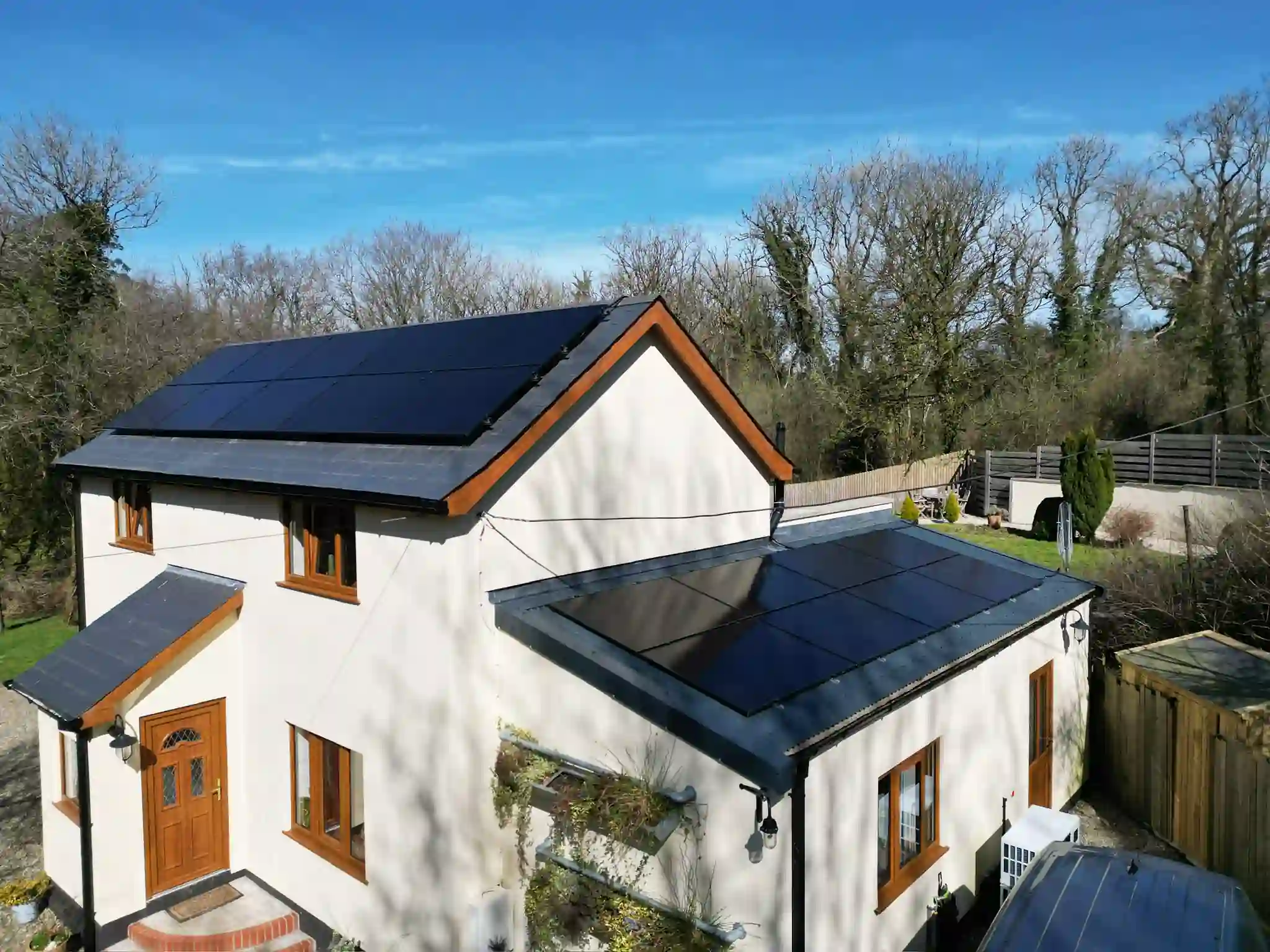
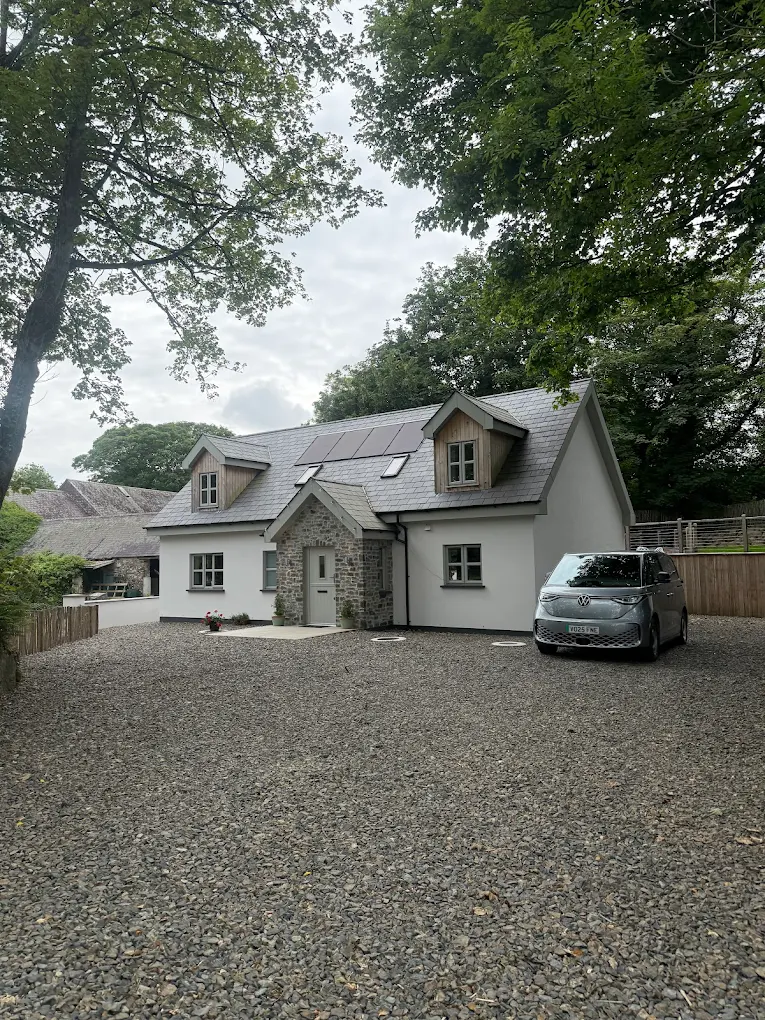
Most solar quotes you'll get use a national average yield — typically 950 kWh per installed kWp. Pembrokeshire is consistently above that, often substantially so on south coast postcodes. We've modelled every full SA postcode area in the county using PVGIS-SARAH3 satellite data and our own monitoring fleet to give an honest, location-specific yield range.
Use these numbers to sanity-check any quote you receive. If an installer claims yields wildly outside these ranges they're either using poor data or they're hoping you don't check.
Annual Yield by Postcode (kWh/kWp)
Modelled at 35° tilt, due south, no shading, with Aiko Neostar ABC 460 W or JA Solar 470 W modules and a modern hybrid inverter (95.5% Euro efficiency).
Methodology: PVGIS-SARAH3 run on 12 August 2026, crystalline Si (c-Si), 35° tilt, azimuth 0° (due south), 14% system losses, fixed-mounted. Centre-of-postcode coordinates used; one representative grid cell per postcode district. [Data sourced: PVGIS-SARAH3 API query run 12 August 2026 (tool version: PVGIS 5.3, dataset: SARAH3, period: 2005–2020 TMY).]
| Postcode | Area | South @ 35° | SE/SW @ 35° | East/West @ 35° |
|---|---|---|---|---|
| SA61 | Haverfordwest | 975 kWh/kWp | 945 | 820 |
| SA62 | St Davids, Solva, Mathry | 1,005 | 975 | 855 |
| SA64 | Fishguard, Goodwick | 990 | 960 | 840 |
| SA65 | Newport, Dinas Cross | 985 | 955 | 835 |
| SA66 | Crymych, Cilgwyn | 965 | 935 | 810 |
| SA67 | Narberth, Templeton | 990 | 960 | 840 |
| SA68 | Kilgetty, Saundersfoot | 1,010 | 980 | 860 |
| SA69 | Saundersfoot south coast | 1,020 | 990 | 870 |
| SA70 | Tenby | 1,025 | 995 | 875 |
| SA71 | Pembroke, Manorbier | 1,015 | 985 | 865 |
| SA72 | Pembroke Dock | 1,005 | 975 | 855 |
| SA73 | Milford Haven, Hubberston | 1,000 | 970 | 850 |
Why South-Coast Postcodes Out-Yield North
Tenby (SA70) consistently lands 50 kWh/kWp/year above Crymych (SA66). Three reasons:
Latitude shift
Tenby sits at 51.67°N vs Crymych's 51.99°N. ~3% more direct beam radiation in summer.
Coastal albedo
Bright sea reflectance off Tenby's bay adds 1–2% diffuse irradiance.
Cloud patterns
Preseli hills generate orographic cloud over Crymych — south coast gets fewer overcast hours.
Module Choice: Aiko Neostar vs JA Solar 470 W
The two modules we install most in Pembrokeshire give very similar yields per installed kWp, but differ in roof footprint, shade tolerance and price.
| Spec | Aiko Neostar 2P 460 W | JA Solar JAM54D42 470 W |
|---|---|---|
| Cell technology | N-type ABC (back-contact) | N-type TOPCon bifacial |
| Module efficiency | 23.6% | 21.8% |
| Dimensions | 1722 × 1134 mm | 1762 × 1134 mm |
| Shade tolerance | Excellent (no busbars on front) | Good (multi-busbar half-cell) |
| Product warranty | 25 years | 25 years |
| Linear performance warranty | 88.85% after 30 years (warranty floor) | 87.4% after 30 years (warranty floor) |
| Best for | Tight roofs, partial shading, max kWp | Larger arrays, ground mounts, value |
Worked Example — 6 kW System in Tenby (SA70)
13 × Aiko Neostar 460 W = 5.98 kWp
- • Yield (south @ 35°): 5.98 kWp × 1,025 = 6,130 kWh/year
- • Self-consumption (no battery, family of 4): ~38% = 2,330 kWh saved at import
- • Export: 3,800 kWh × 12p (typical fixed SEG tariff) = £456
- • Import saved: 2,330 kWh × 26.11p (Ofgem cap July–September 2026, changes quarterly) = £608
- • Year-1 financial benefit: ~£1064
Add a Fox ESS EP5 5 kWh battery and self-consumption rises to ~75%, lifting year-1 benefit to ~£1,500.
Pembrokeshire-specific yield notes
- • Coastal salt does not reduce panel output if cleaned or rained on regularly — but uncleaned years can lose 2–3%.
- • Pembrokeshire Coast National Park properties may need in-roof systems — see our Solfit in-roof guide — which knock 4–6% off the figures above.
- • East-west split arrays produce ~92% of south-only yield but flatten the daily curve — better for self-consumption with a heat pump.
Tilt and Shading Sensitivity
Pembrokeshire's typical roof pitch is 30–45° on slate-covered properties, with a strong south-east bias on Victorian terraces in Tenby, Pembroke Dock and Milford Haven. Yield is surprisingly forgiving across this range — but localised shading from chimneys, gables and trees can cost more than orientation does.
| Orientation | Tilt 20° | Tilt 35° | Tilt 50° |
|---|---|---|---|
| South (180°) | 94% | 100% | 96% |
| SSW (202°) | 93% | 99% | 95% |
| SW (225°) | 90% | 95% | 91% |
| East/West | 82% | 84% | 81% |
| East+West split | 86% | 88% | 86% |
% of optimum south-facing 35° yield, modelled in PVGIS for Haverfordwest reference site.
The shading rule of thumb
A single shaded module without optimisers can drag a string's yield down by 30–50%. With Tigo or Solar Edge optimisers, that drops to 5–8%. For any Pembrokeshire roof with a chimney within 1.5 m of the array, optimisers pay back in 3–4 years.
Panel-Level Optimisation: When It's Worth It
Optimisers add ~£800–£1,200 to a 4 kWp install. They're not a default — but for these Pembrokeshire scenarios they're a clear-cut yes:
Specify optimisers when…
- Any chimney, dormer or vent on the array roof
- Mature tree within 20 m on the south side
- East+west split arrays
- Multi-pitch roofs feeding one inverter
- Listed buildings where small arrays must hit max yield
Skip optimisers when…
- Clean unobstructed south or south-west roof
- Single-pitch field-mount or barn roof
- Hybrid inverter with built-in MPPT optimisation already
- Small arrays under 3 kWp where the optimiser cost is disproportionate
Aiko Neostar 2P vs JA Solar DeepBlue 4.0
The two modules we specify by default differ in subtle ways that matter for Pembrokeshire's diffuse light and salt-air conditions.
| Spec | Aiko Neostar 2P 460 W | JA Solar DeepBlue 4.0 440 W |
|---|---|---|
| Cell tech | ABC (All Back Contact) N-type | N-type TOPCon bifacial |
| Module efficiency | 23.6% | 22.5% |
| Performance @ 800 W/m² | Higher (low-light advantage) | Standard |
| Bifacial gain | N/A (front-only) | +5–15% on white surfaces |
| Linear output warranty | 88.85% after 30 years (warranty floor) | 87.4% after 30 years (warranty floor) |
| Best Pembrokeshire fit | Roof arrays, low-light heavy yields | Ground/farm arrays, high-albedo surfaces |
Battery and Solar Yield Interaction
Adding a battery doesn't increase solar generation but it dramatically changes the share of generation you actually use. On a 4 kWp Pembrokeshire array generating 3,800 kWh/yr:
- No battery, no diverter: ~28% self-consumed, 72% exported.
- Hot-water diverter (e.g. iBoost): ~42% self-consumed, 58% exported.
- 5 kWh battery: ~62% self-consumed, 38% exported.
- 10 kWh battery + diverter: ~78% self-consumed, 22% exported.
- 10 kWh battery + EV charging: 90%+ self-consumed in summer.
Solar Yields FAQ
How accurate are PVGIS yields?
Within ±5% of measured yields for properly installed Pembrokeshire systems. We anchor every quote to PVGIS modelling for the specific postcode, then apply a 3% real-world correction factor based on monitored data from our existing customers.
Why do some installers quote 1,100 kWh/kWp?
They're using STC datasheet figures or southern-England averages. Pembrokeshire's real long-term average is 950–1,000 kWh/kWp for a clean south-facing 35° array. Anyone quoting more is over-promising.
Does the sea spray affect yield?
A clean array out-yields a salt-fouled array by 4–6% over a winter. Coastal sites need a rinse twice a year — usually self-cleaning rain handles the rest. Specify modules with anti-soiling coatings for properties within 500 m of the cliff edge.
Can I expect 100% offset?
Annually, yes — most Pembrokeshire homes can match generation to consumption on paper. But the seasonal mismatch is severe: 75% of generation falls April–September, vs 65% of consumption October–March. Without a battery or grid export-import, real offset is closer to 30–40%.
What's the right system size for my house?
For a typical 3-bed Pembrokeshire home consuming 3,500–4,500 kWh/yr, a 4–5 kWp array is the sweet spot. With a heat pump, push to 6–8 kWp. With an EV plus heat pump, 8–10 kWp + battery. Anyone selling you a 12 kWp system on a 3-bed without that combination is probably oversizing.
Get a Quote Anchored to Real Yields
We model every Pembrokeshire quote in PVGIS using your exact roof orientation, tilt and shading, then show you the working. No optimistic assumptions, no national averages.