

Sizing a Heat Pump for Pembrokeshire's Coastal Climate
How to size an air source heat pump for Pembrokeshire's mild but wind-driven coastal climate, why MCS 3005 design temperatures matter, and how R290 monoblocs (Vaillant aroTHERM Plus, Midea) hold their SCOP through the worst of a Welsh winter.
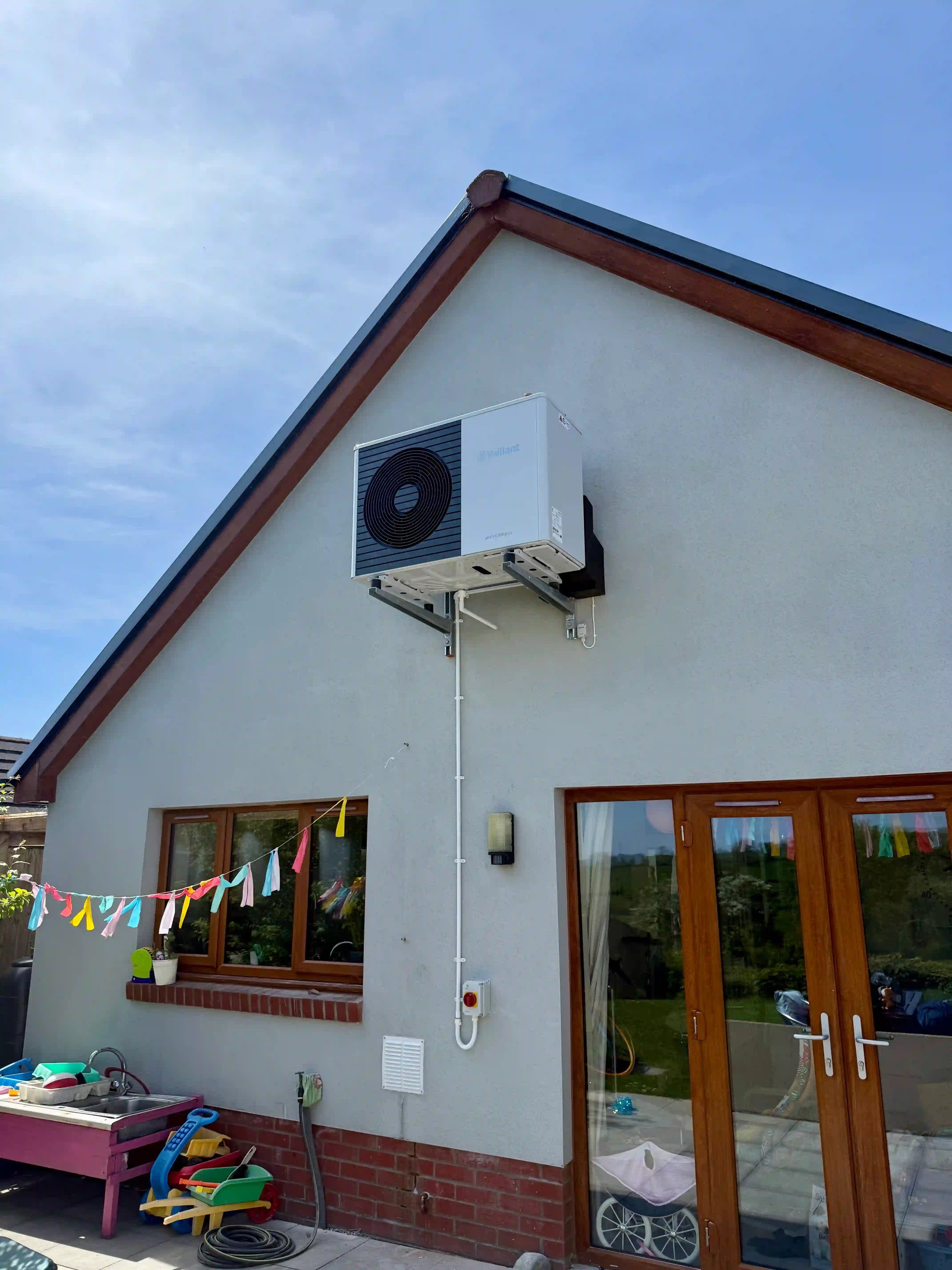
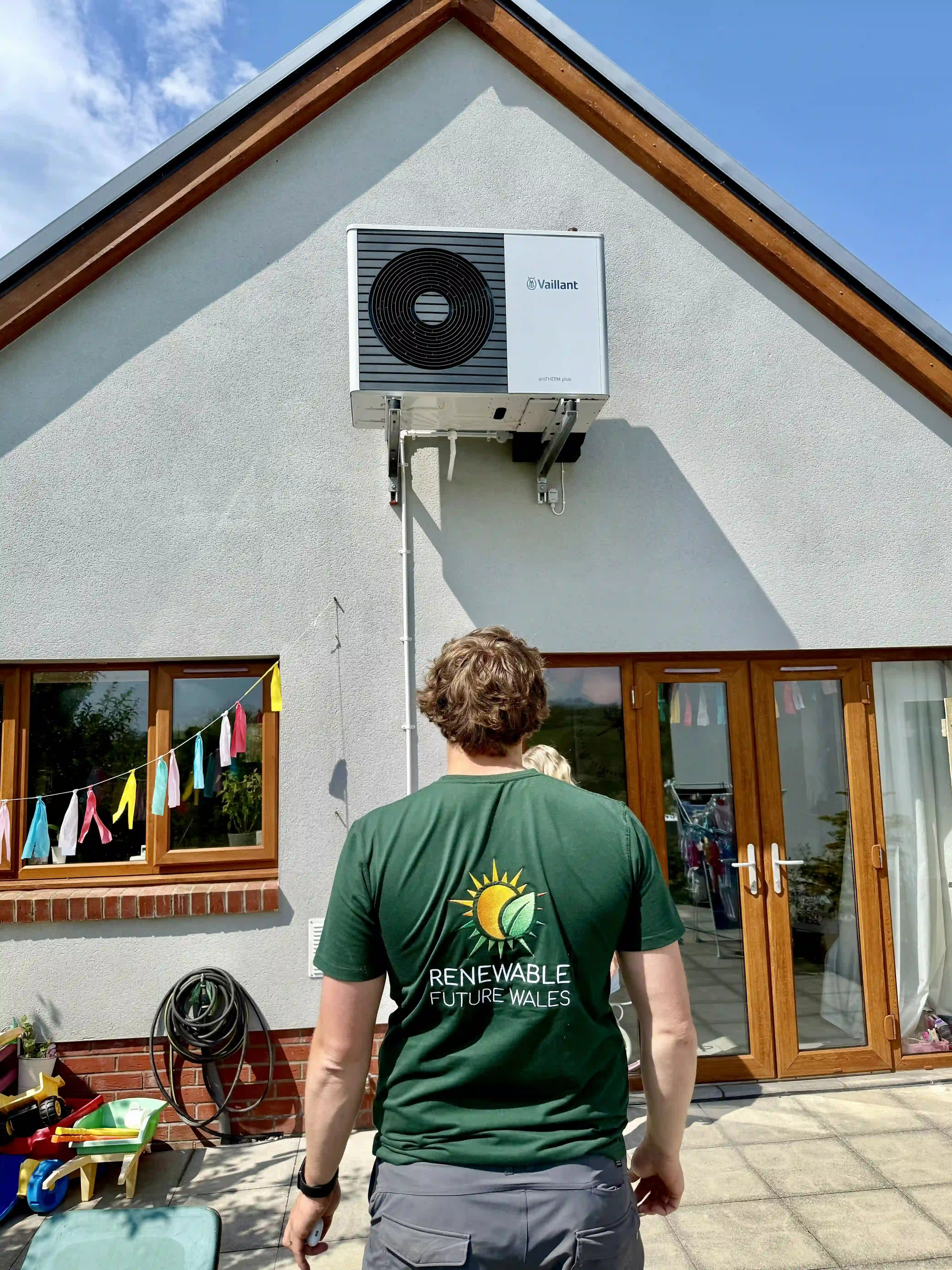
Pembrokeshire enjoys one of the mildest winter climates in the UK. The Met Office 1991–2020 average minimum for Milford Haven is +3.4 °C in February — warmer than London. So why do half the heat pumps installed in the county still struggle on the coldest February nights? Because they were sized for an average winter, not the design winter.
This article works through the numbers MCS 3005 expects, the design outdoor temperature you should be using for SA postcodes, and the refrigerant choice that lets a heat pump shrug off coastal cold snaps and Atlantic gales.
Pembrokeshire's Design Outdoor Temperature
MCS 3005 specifies the design outdoor temperature as the value exceeded for 99.6% of the heating season at that postcode. For coastal SA postcodes the figures we use are:
| Postcode area | Approx location | Design outdoor temp | Mean Jan/Feb min |
|---|---|---|---|
| SA61–SA62 | Haverfordwest, Rudbaxton | −2.8 °C | +3.0 °C |
| SA64–SA65 | Fishguard, Goodwick | −2.5 °C | +3.4 °C |
| SA66–SA67 | Crymych, Narberth (inland) | −3.6 °C | +2.1 °C |
| SA70–SA73 | Tenby, Pembroke, Milford | −2.2 °C | +3.5 °C |
Why the Coast Behaves Differently
The Atlantic stops temperatures dropping as low as inland Wales, but coastal Pembrokeshire has its own challenges:
- • Wind chill on the heat pump: 60+ mph southwesterlies push apparent temperatures down 5–8 °C and accelerate frost build-up on the evaporator.
- • High humidity (85–95%): Defrost cycles run more often than inland, so SCOP drops faster than the temperature alone suggests.
- • Salt air corrosion: Within 1.5 km of the coast, marine-grade fin coatings and stainless mounting are not optional.
Heat-Loss Calculation Under MCS 3005
MCS MIS 3005 (the MCS Installation Standard for heat pump systems, 2024 edition) requires a room-by-room calculation using actual U-values, ventilation rates, internal design temperatures (21 °C living, 18 °C bedrooms, 22 °C bathrooms) and the local design outdoor temperature. Anyone offering you a "rule of thumb" sizing — 1 kW per 25 m² is the classic — is not following the standard.
Inputs the Calc Needs
- • U-values for every external element
- • Air permeability (Q50) — measured or assumed
- • Window orientation and g-value
- • Cold-bridge psi-values
- • DHW occupancy (BS EN 12831-3)
- • Local design outdoor temp (table above)
Outputs You Should See
- • Total design heat loss (kW)
- • Per-room emitter sizing at chosen flow temp
- • DHW reheat profile (kWh/day)
- • Predicted SCOP at the chosen flow temp
- • Annual electricity consumption (kWh)
- • Sound assessment for outdoor unit position
SCOP at +2 °C, −2 °C and the BUS Default
Manufacturer SCOP figures (Vaillant aroTHERM Plus quotes 5.03 at 35 °C flow; Midea up to 4.9) are measured under EN 14825 and represent an averaged European climate. Pembrokeshire conditions land somewhere between the "warm" and "average" climate zones. Real-world SCOP is what matters:
| Condition | Vaillant aroTHERM Plus 7 kW (R290) | Typical R32 7 kW unit |
|---|---|---|
| A7/W35 (mild day, UFH) | COP 5.0 | COP 4.7 |
| A2/W45 (typical Pembs winter) | COP 3.7 | COP 3.4 |
| A−2/W50 (cold snap) | COP 3.1 | COP 2.7 |
| A−7/W55 (rare, inland) | COP 2.6 | COP 2.1 (often derated) |
| Annual SCOP (modelled for coastal SA) | 3.9–4.2 | 3.4–3.7 |
Why R290 Wins on the Welsh Coast
R290 (propane) has a higher critical temperature than R32, which means it can deliver high flow temperatures without the compressor being driven outside its efficient envelope. For a coastal property that occasionally sees −3 °C and prevailing humidity, this matters in three ways:
Flow Temperatures up to 75 °C
R290 can do legionella cycles and feed older oversized radiators without an immersion top-up.
Less Derating in the Cold
R290 units hold their output much better below 0 °C than R32 units, which are often significantly derated at the −7 °C design condition — meaning your heating capacity falls precisely when you need it most.
GWP of 3, not 675
Future-proof against the F-gas phase-down and EU/UK refrigerant restrictions.
Pembrokeshire Coast Sizing Watch-outs
- • Don't oversize. A 12 kW unit in a 6 kW house cycles constantly, hammering SCOP and the compressor.
- • Allow for DHW load on top of space-heat — typical Pembrokeshire family home adds 2–3 kW peak.
- • Position the outdoor unit clear of prevailing southwesterlies if possible — ideally on the north or east elevation, with a 1 m R290 zone clear of doors and openings.
- • For coastal sites within 1.5 km of the sea, specify Vaillant's blue-fin coating or equivalent marine-grade evaporator protection.
Coastal vs Inland: Two Real Pembrokeshire Calcs
The same property type can have very different heat-loss numbers depending on whether it's exposed to Atlantic frontal weather or sheltered inland. Here are two side-by-side MCS 3005-D calcs for nominally similar 4-bed detached houses, both built ~1985, both 142 m² heated floor area:
| Parameter | Coastal (St Brides Bay, SA62) | Inland (Crymych, SA41) |
|---|---|---|
| External design temp | -1.5°C | -3.5°C |
| Wind exposure factor | 1.20 (very exposed) | 1.05 (sheltered) |
| Fabric heat loss | 7.2 kW | 7.0 kW |
| Ventilation/infiltration | 2.4 kW (driven up by wind) | 1.6 kW |
| Total design heat loss | 9.6 kW | 8.6 kW |
| Recommended unit | aroTHERM Plus 10 kW | aroTHERM Plus 7 kW (with HW boost) |
Notice the wind exposure factor and infiltration losses dominate the difference, not the fabric. This is why simple "kW per m²" rules of thumb fail near the Pembrokeshire coast — they ignore the air-change multiplier in MCS 3005-D Annex E.
Defrost Cycle Behaviour at the Coast
Pembrokeshire winters are mild but humid — relative humidity sits at 85–95% from November to March, and temperatures hover around 2–6°C. That's exactly the sweet spot for frost build-up on the heat-pump evaporator coil. Sizing has to account for the SCOP penalty of frequent defrosts.
Reverse-cycle defrost (Vaillant aroTHERM Plus)
Brief reversal of the refrigerant cycle to melt frost off the outdoor coil. Typical interval at 3°C/90% RH: every 45–60 min, lasting 2–4 min each.
SCOP impact: 4–7% reduction below datasheet. Mitigation: 50 L volumiser + glycol-protected primary loop holds heat for the heating circuit during defrost.
Hot-gas bypass defrost (Midea R290)
Routes hot discharge gas through the evaporator without full reversal. Less disruptive to the heating circuit but slower defrost — typically 4–6 min cycles.
SCOP impact: 3–5% reduction. Better suited to UFH systems where stored thermal mass smooths out the cycle.
Pembrokeshire defrost watch-outs
- Drain heater: on coastal sites, the condensate drain can ice over in still windless conditions. Vaillant's optional drain-pan heater is non-negotiable for properties near salt water.
- Plinth height: minimum 250 mm above ground on coastal exposure to clear ice build-up under the unit. We typically use 350 mm stainless-steel plinths for SA61–SA64 postcodes.
- Wind shield: cross-coast winds can stall fan rotation and drive horizontal rain into the coil. A vented wooden screen 0.6 m off the unit cuts both noise and wind ingress.
Choosing Between aroTHERM Plus, Midea R290 and Mitsubishi Ecodan
Once you know the design heat loss, you choose a unit that hits flow temp 50°C with margin at the design external temp. For Pembrokeshire that usually means the next size up from the calc — never the next size down.
| Unit | Output @ -2°C/45°C | SCOP (35°C) | Sound (1m) | Best for |
|---|---|---|---|---|
| aroTHERM Plus 5 kW | 4.2 kW | 4.69 | 52 dB | Insulated 3-bed semis inland |
| aroTHERM Plus 7 kW | 5.8 kW | 4.65 | 54 dB | Most Pembrokeshire 3-bed detached |
| aroTHERM Plus 10 kW | 8.4 kW | 4.55 | 56 dB | 4-bed coastal/exposed sites |
| Midea M-Thermal R290 8 kW | 6.7 kW | 4.78 | 53 dB | UFH-led new builds |
| Midea M-Thermal R290 12 kW | 10.1 kW | 4.62 | 55 dB | Larger farmhouses |
Sizing FAQ
Why not just oversize the heat pump to be safe?
Because oversizing kills SCOP. A 10 kW unit running on a 5 kW load short-cycles, the compressor never reaches steady state, and you lose 10–15% efficiency over a winter. The BUS grant is also capped (up to £9,000 for oil/LPG (applications 21 Jul 2026–31 Mar 2027), £7,500 on mains gas), so you don't save money by going bigger.
Should I include a backup electric heater?
Vaillant aroTHERM Plus has an integrated 6 kW backup heater in the indoor unit. We commission it disabled for normal running and only enable it for DHW boost or as a fallback on the coldest days. In a properly sized system it runs less than 100 hours/year.
Does my hot water demand affect heat-pump sizing?
Slightly. We typically add 0.5 kW per occupant to the heating design load to allow for simultaneous DHW recovery. A 4-person household pushes a 7 kW heating load to ~9 kW peak demand — fine for an aroTHERM Plus 10 kW.
What's a realistic SCOP for my Pembrokeshire home?
For a properly designed system on weather-compensated 35–40°C flow, expect SCOP 3.6–4.1 in real Pembrokeshire conditions. Datasheet SCOPs (4.5+) assume EN 14825 averaged climate which is colder and drier than our coast.
Can I size on EPC data?
No. EPCs use SAP, which underestimates wind-driven losses by 20–30% in coastal locations. MCS 3005-D requires a measured-and-modelled heat loss for grant approval — we use Heat Engineer or PHPP for the calc.
Get the Numbers Right Before You Buy
We carry out full MCS 3005 heat-loss surveys across Pembrokeshire and only quote on the actual numbers — no rules of thumb, no oversizing. R290 specifications from Vaillant aroTHERM Plus and Midea are matched to your property and design temperature.