

Oil Boiler to Vaillant aroTHERM plus Conversion in Pembrokeshire
Around 24,000 Pembrokeshire homes still heat with oil. This is the step-by-step retrofit playbook for swapping a tired Worcester or Grant kerosene boiler for a Vaillant aroTHERM plus R290 heat pump — plus the running-cost numbers we see on real installs.
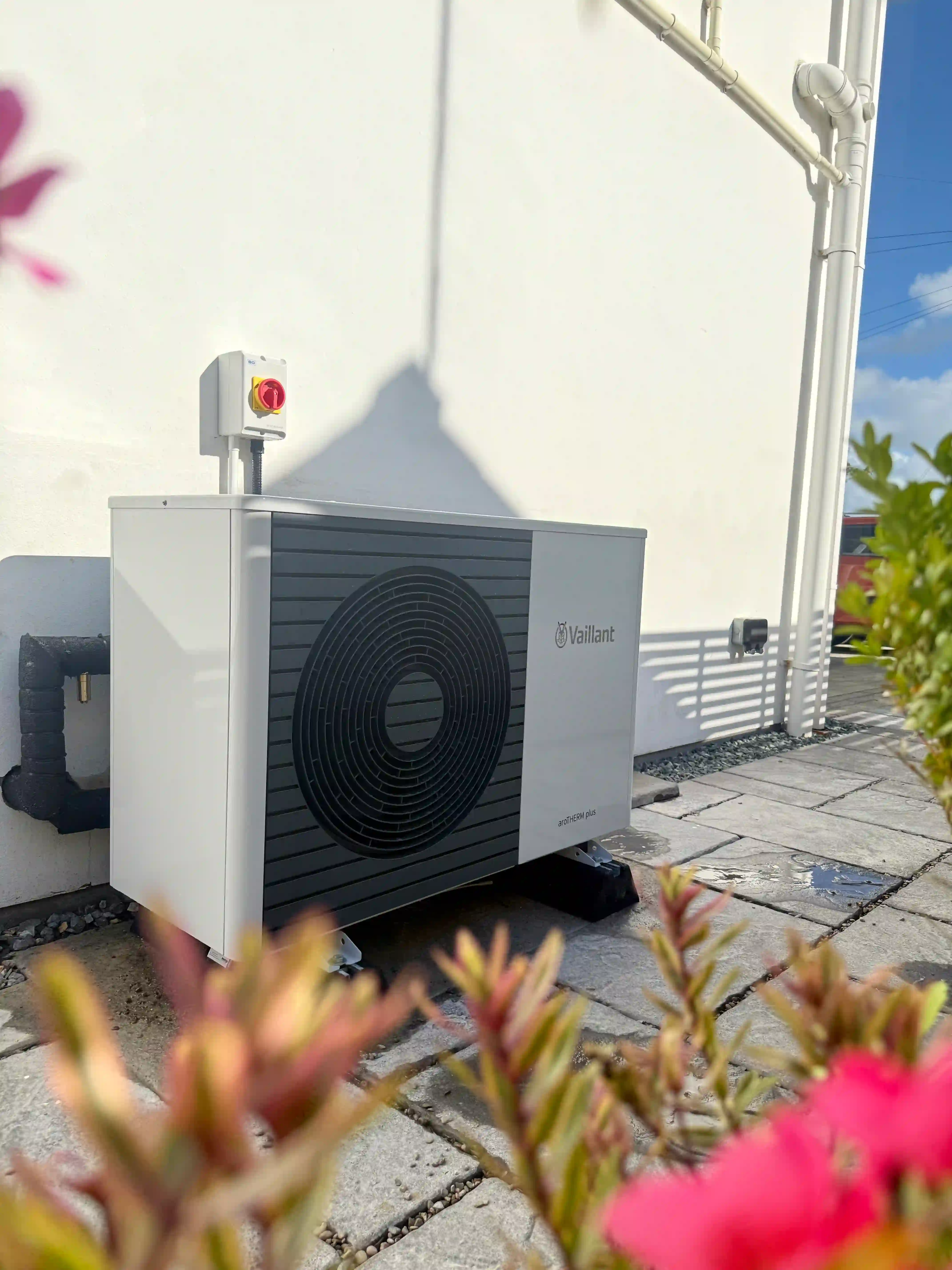
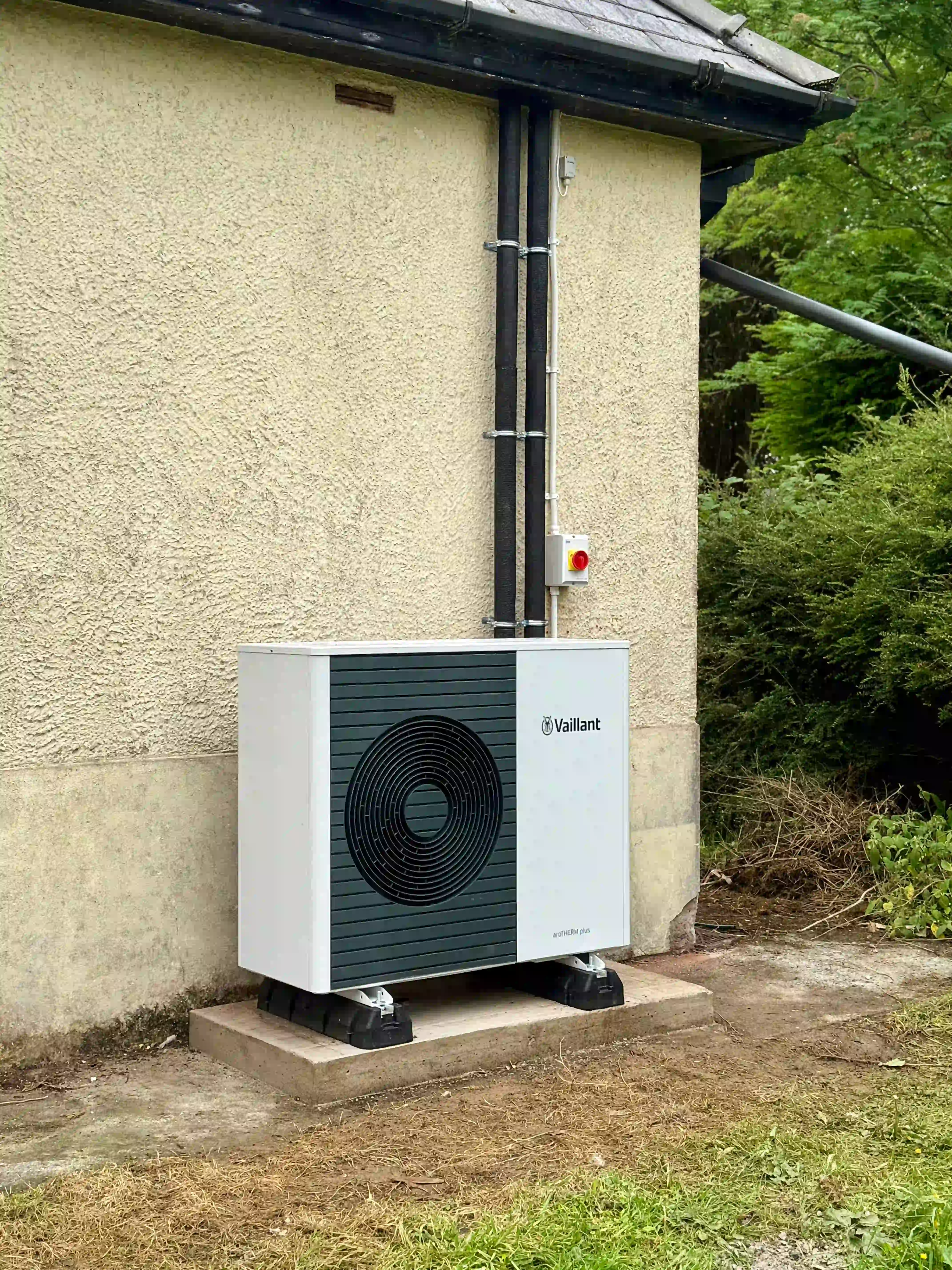
Pembrokeshire has one of the highest concentrations of off-grid oil heating in the UK. With kerosene volatile between 70–95 p/litre and oil boilers facing the 2035 phase-out for new installations under the Future Homes Standard, oil-to-heat-pump is now the most common conversion we do.
This guide is the practical retrofit playbook: what comes out, what stays, what's new, and what the homeowner sees on day 90 when the first quarter's electricity bill arrives.
Why aroTHERM plus for Oil Conversions
Oil boilers run hot — 70–80 °C flow temperatures are typical. The radiators in an oil-heated Pembrokeshire farmhouse are usually undersized for low-temperature operation. The Vaillant aroTHERM plus is the most forgiving heat pump for these conversions because it can run flow temperatures up to 75 °C using R290 refrigerant, so a fabric upgrade and partial radiator swap can be staged rather than done all at once.
aroTHERM plus VWL — Conversion Range
Available outputs
- • VWL 35/6 — 3.5 kW (small cottage)
- • VWL 55/6 — 5 kW (well-insulated semi)
- • VWL 75/6 — 7 kW (typical 3-bed farmhouse)
- • VWL 105/6 — 10 kW (large/poorly insulated)
- • VWL 125/6 — 12 kW (sub-divided + DHW heavy)
Why it suits oil conversions
- • 75 °C flow — works with existing radiators
- • R290 monobloc — no F-gas indoor work
- • Built-in legionella cycle for DHW
- • 7 yr standard / 10 yr Mastertech warranty
- • MCS-listed for BUS grant eligibility
The Conversion: Day-by-Day
Day 1 — Strip-out and 1st fix
Decommission the oil boiler, drain the system, cap the kerosene line. Lift any radiators flagged for upgrade. Run new 22 mm primaries to the cylinder location. Pour the outdoor unit slab.
Day 2 — Cylinder and pipework
Install the Vaillant uniSTOR VIH RW 200/3 BR or 300/3 BR heat-pump cylinder with fast-recovery 3 m² coil. Run the pre-insulated flow/return out to the slab. New radiator install starts.
Day 3 — Outdoor unit set
Crane or 2-man-lift the aroTHERM plus monobloc onto the slab. Antifreeze flow/return connection (no F-gas work). Dedicated 32 A radial from the consumer unit, MCB and RCBO. Type II surge protection.
Day 4 — Commissioning
Power flush whole system, glycol fill, sensoCOMFORT VRC 720 pairing, weather-comp curve set, DHW schedule, legionella cycle test, MCS commissioning report. Customer handover and BUS grant submission.
Running Costs: Oil vs aroTHERM plus
Real numbers from a 165 m² 4-bed Pembrokeshire farmhouse near Letterston, MCS-surveyed at 9.2 kW design heat loss after sensible loft top-up, switched from a Grant Vortex Pro 26 kW oil boiler to a 7 kW aroTHERM plus in October 2024:
| Year | Heating + DHW demand | Energy used | Cost |
|---|---|---|---|
| Oil — at current kerosene price | 22,400 kWh | 2,500 L kerosene | £2,306 @ 92.24p/L (BoilerJuice UK avg, 11 Aug 2026 — oil has moved ~20% in two months; volatile) |
| aroTHERM plus — at current cap | 22,400 kWh | 5,600 kWh elec @ SCOP 4.0 | £1,462 @ 26.11p/kWh (Ofgem cap July–September 2026 — resets quarterly) |
| Annual saving vs oil at 92.24p/L | £844 (~37%) | ||
| With Octopus Cosy + 6 kW PV | £900–£1,100 (~50%) (modelled at Cosy ~13p/kWh in the 04:00–07:00, 13:00–16:00 and 22:00–00:00 windows; checked Aug 2026 — verify live rate at publish) | ||
Pembrokeshire-specific considerations
- • Oil tank decommission: Bunded tanks must be drained, cleaned and either lifted or repurposed. Allow £400–£900.
- • Three-phase rural farms: Many off-gas farms have 3-phase supply already — useful for larger 12–16 kW units without DNO upgrades.
- • DNO load notification: National Grid Electricity Distribution (NGED, formerly Western Power Distribution) requires a load-connection notification for heat pumps drawing more than 16 A on a single phase (broadly: anything above ~3.68 kW absorbed power). This is a load notice — not a G98/G99 generation notice — and is submitted before commissioning.
- • Listed buildings: Common in National Park villages; outdoor unit siting consent must be agreed before contract.
BUS Grant Mechanics
Oil boilers are explicitly eligible properties under the Boiler Upgrade Scheme — in fact, off-grid oil replacements are the single largest category of BUS applications in Wales. For voucher applications from 21 July 2026 to 31 March 2027 the grant is £9,000 for oil and LPG-heated homes (£7,500 on mains gas or electric), paid to the installer and discounted on your invoice. Full eligibility detail in our BUS guide.
Typical Conversion Pricing
Decommissioning the Oil Tank Properly
The heating-system swap is only half the conversion job. The oil tank, fill point, vent pipe and any buried supply line all need decommissioning under the relevant OFTEC technical bulletin before you call the project finished. Pembrokeshire County Council requires written confirmation of safe decommissioning for any property in a Source Protection Zone (large parts of the catchment around the Cleddau and Western Cleddau qualify).
Step 1 — Consume or recover remaining fuel
Run the existing boiler down to the bottom 50 mm before changeover. Residual oil is pumped out by an OFTEC-registered operative for recycling — typically £80–£140 for a 1,300 L tank.
Step 2 — Disconnect, purge and cap
Supply line is purged of vapour with inert gas (typically nitrogen), capped at the boiler-end and at the tank outlet. Vent and fill pipe are sealed; tank gauge removed.
Step 3 — Tank removal or in-situ decommissioning
Plastic single-skin tanks are usually cut up and removed (£250–£450). Bunded steel tanks can be sold for scrap, offsetting some cost. In-situ decommissioning (sand-fill, secure cap) is allowed where removal would damage the property — but only with council agreement.
Step 4 — OFTEC certificate and PCC notification
An OFTEC certificate of decommissioning is issued by the engineer. Where required, this is uploaded to the council planning portal as evidence of safe completion.
Hot Water Cylinder Choice After Conversion
Most oil boilers in Pembrokeshire are paired with vented gravity-fed cylinders sized for 60–70°C boiler water. Heat pumps want unvented, high-recovery, low-loss cylinders. The choice of cylinder is one of the biggest determinants of whole-system SCOP.
| Cylinder | Coil area | Recovery @ 50°C flow | Standing loss | Fit |
|---|---|---|---|---|
| Vaillant uniSTOR VIH RW 200/3 BR | 3.0 m² | 200 L in 28 min | 1.4 kWh/24h | 2-bath family home |
| Vaillant uniSTOR VIH RW 300/3 BR | 3.5 m² | 300 L in 38 min | 1.7 kWh/24h | 3-bath / occasional B&B |
| Joule Cyclone HP+ 250 | 4.2 m² | 250 L in 30 min | 1.5 kWh/24h | Premium retrofit / DHW-heavy |
BUS Grant Walk-Through for Pembrokeshire Owners
The Boiler Upgrade Scheme is the dominant funding route for oil-to-heat-pump conversions in Pembrokeshire. Welsh Government also runs the Nest scheme for income-eligible households. We handle the paperwork on your behalf — but here's the process so you know what's happening.
- Eligibility check. Owner-occupied or small-business property in England/Wales. No EPC or insulation conditions apply — these requirements were removed from the BUS in 2024.
- MCS-certified design. Heat-loss survey to MCS 3005-D and emitter schedule. The MCS certificate is what unlocks the grant.
- Voucher application. Installer submits to Ofgem on your behalf — you sign a customer declaration. Voucher is issued before installation begins.
- Install and commission. System is installed, commissioned, customer signs handover.
- Voucher redemption. Installer redeems the £9,000 voucher (oil/LPG, applications 21 Jul 2026–31 Mar 2027) against the invoice — you only pay the net figure. Ofgem audits a sample of installations.
Conversion FAQ
How long without heating during the conversion?
Usually one cold day. We commission the new system on the same day we strip the old boiler — fabric upgrades, radiator changes and pipework alterations are scheduled in advance to minimise disruption.
Will my radiators be hot to the touch?
Yes — but warm rather than scalding. At 45°C flow temp the radiators feel "warm bath" temperature. Rooms reach setpoint just as quickly because the rads are bigger and run for longer.
Can I keep my Aga / oil cooker?
Yes — the BUS grant only requires you replace your primary heating fuel. Standalone oil cookers are unaffected. Many Pembrokeshire farmhouses keep their Aga for cooking and ambient heat in the kitchen.
What about the OFTEC service contract I just renewed?
Most providers will refund pro-rata. The annual heat-pump service replaces the oil boiler service and is typically £30–£60 cheaper.
What if I want to keep oil as a backup?
Technically possible (a "hybrid" system), but you lose BUS grant eligibility — the grant requires the heat pump to be the sole/primary heating source. Oversize the heat pump correctly and you don't need a backup.
Switching Off the Oil This Year?
We're a Vaillant Mastertech installer covering all of Pembrokeshire. Get an MCS survey and a fixed-price conversion quote with the BUS grant already deducted.