

Retrofitting an Air Source Heat Pump in a Pembrokeshire Stone Cottage
A fabric-first guide to making a 19th-century stone cottage heat-pump-ready: U-values, heat-loss numbers, radiator sizing for low flow temperatures, and a real Vaillant aroTHERM Plus 7 kW retrofit specification.
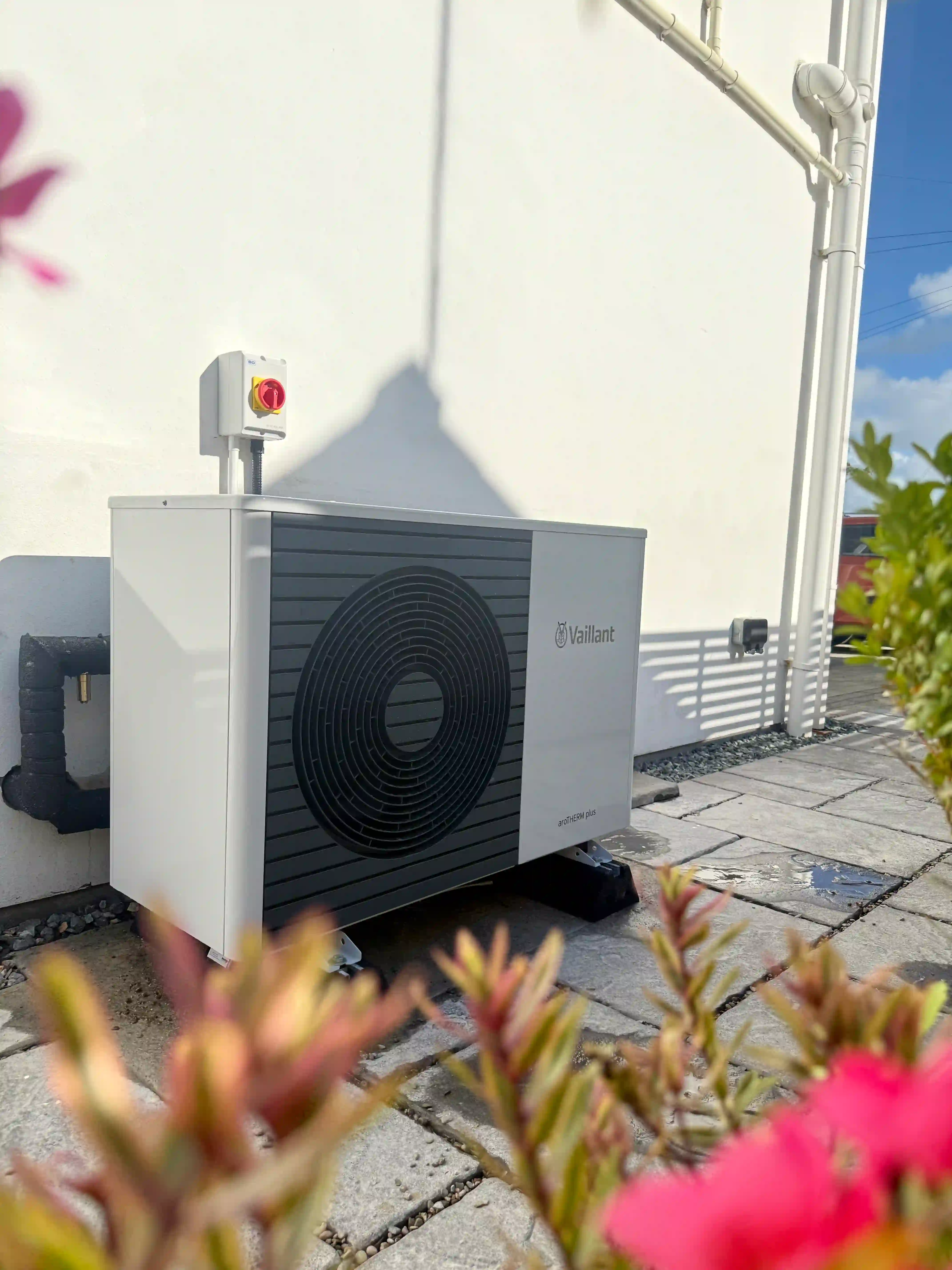
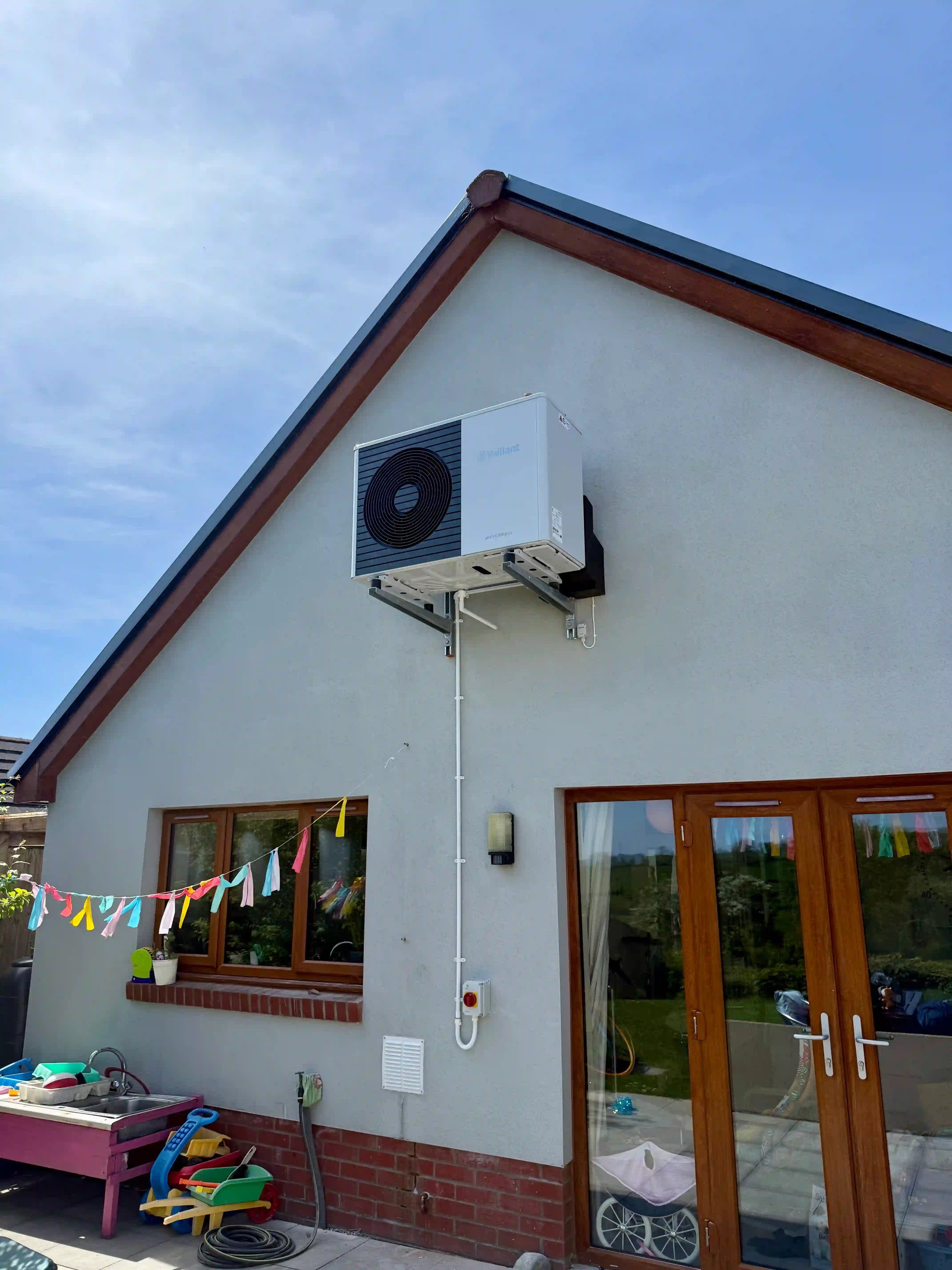
Pembrokeshire's solid-stone cottages — from Newport's coastal terraces to the rubble-built farmhouses around Crymych and Maenclochog — were never designed for low-temperature heating. Walls are typically 500–600 mm of unventilated stone with lime mortar; floors are flagstone over earth; windows are single-glazed timber.
A successful air source heat pump retrofit in this kind of property starts long before the heat pump arrives. This guide walks through the fabric-first survey, the heat-loss numbers we typically see, the radiator upgrades needed for a Vaillant aroTHERM Plus running at 45 °C, and the BUS grant maths.
Why Fabric First Matters in a Stone Cottage
Heat pumps don't care how much heat your house needs — they care about the flow temperature at which that heat is delivered. Every degree you can drop the flow temperature lifts SCOP by roughly 2–2.5%. A stone cottage with leaky windows and an uninsulated loft will demand 65 °C+ flow on a cold January night, dragging a heat pump's seasonal performance down to SCOP 2.8 or worse. Tighten the fabric first and the same property runs comfortably at 45 °C with SCOP 3.8–4.2.
Typical Pembrokeshire Stone Cottage U-values (Pre-Retrofit)
Typical published values (CIBSE Guide A / standard retrofit references); we measure per property on survey.
- • Solid stone walls: 1.7–2.1 W/m²K (target post-retrofit: 0.45–0.6)
- • Single-glazed timber sash: 4.8–5.2 W/m²K (target: 1.4 with secondary glazing or 1.2 with slim-profile DG)
- • Suspended timber floor over void: 0.7–0.9 W/m²K (target: 0.18–0.22)
- • Uninsulated pitched roof: 1.9 W/m²K (target: 0.15)
- • Air permeability: 12–18 m³/(h·m²) at 50 Pa (target: under 7)
The MCS Survey: What Numbers You Need
MCS 3005 mandates a room-by-room heat-loss calculation using a design outdoor temperature of -2.8 °C for Pembrokeshire's coastal SA postcodes. We typically see three classes of results:
Untouched Cottage
130 m² traditional, no insulation
- • Heat loss: 11.5–13 kW
- • Flow temp needed: 65–70 °C
- • Modelled SCOP at 65–70 °C flow: 2.6–2.9
- • Verdict: Don't fit the pump yet
Sensible Retrofit
Loft + floor + draught-proofing
- • Heat loss: 7–8 kW
- • Flow temp: 50 °C
- • Modelled SCOP at 50 °C flow: 3.5–3.8
- • Verdict: Vaillant 7 kW works
Deep Retrofit
+ IWI on cold elevations
- • Heat loss: 4.5–5.5 kW
- • Flow temp: 40–45 °C
- • Modelled SCOP at 40–45 °C flow: 4.0–4.4
- • Verdict: 5 kW unit + UFH viable
Specifying the Vaillant aroTHERM Plus 7 kW
For most Pembrokeshire stone cottages after sensible fabric upgrades, the Vaillant aroTHERM Plus VWL 75/6 A 230V S3 (7 kW nominal at A7/W35) is the right choice. It's a R290 monobloc — no refrigerant pipework crosses the building envelope, no F-gas certification is needed for the indoor work, and R290 keeps efficiency up at low ambient temperatures where R32 units start to derate.
Vaillant aroTHERM Plus 7 kW — Spec Snapshot
- • Nominal output: 7 kW @ A7/W35
- • Refrigerant: R290 (GWP 3)
- • Max flow temp: 75 °C
- • Operating range: -25 °C to +46 °C ambient
- • SCOP @ 35 °C flow: up to 5.03
- • Sound power: 54 dB(A) at 1 m (Quiet Mark)
- • Manufacturer warranty: 7 years (10 with Mastertech install)
- • Controls: sensoCOMFORT VRC 720
Radiator Sizing for 45 °C Flow
The single biggest mistake on stone-cottage retrofits is leaving the existing radiators in place. Cast-iron column radiators sized for 75 °C flow lose roughly 55% of their output when you drop to 45 °C. Each room's emitters must be re-sized against the new heat-loss figure at the new flow temperature.
| Room | Heat Loss | Existing (75 °C) | Replacement (45 °C) |
|---|---|---|---|
| Living room (22 m²) | 1,650 W | DC 600×1000 (1,200 W) | K3 600×1800 (2,050 W) |
| Kitchen (14 m²) | 1,050 W | SC 600×800 | K2 600×1400 (1,250 W) |
| Master bedroom (16 m²) | 800 W | SC 600×600 | K2 600×1000 (900 W) |
| Bathroom (5 m²) | 450 W | Towel rail 1200×500 | K2 600×600 + towel rail |
Pembrokeshire Stone Cottage Watch-outs
- • Internal wall insulation (IWI) on solid stone needs a vapour-open build-up — wood-fibre boards or lime/hemp, never PIR direct to stone, or you'll trap moisture.
- • Bat surveys are common for older cottages and listed buildings under Pembrokeshire Coast National Park; factor 4–8 weeks into the programme.
- • External unit siting needs to keep the 1 m R290 zone clear of openings; the salty maritime air means we always specify a marine-grade plinth and stainless fasteners.
- • Existing pipework in older properties is often 15 mm microbore — heat-loss calcs must check pipe sizing for the new flow rates, often 22 mm primaries are needed.
The £9,000 BUS Grant Maths (Oil/LPG, applications 21 Jul 2026–31 Mar 2027)
The Boiler Upgrade Scheme grant is paid to the installer and offset on your invoice. For a typical Pembrokeshire stone cottage retrofit we see net costs around £3,000–£7,000 after the £9,000 grant (most cottages are off-grid oil or LPG, which qualifies for the higher tier for applications made 21 July 2026–31 March 2027 — mains-gas properties get £7,500). Full eligibility rules are in our BUS guide.
Worked Example — 130 m² Stone Cottage near Mathry
Phase-by-Phase Retrofit Timeline
Done well, a Pembrokeshire stone-cottage retrofit takes 4–9 months from first survey to a fully commissioned system. The bottleneck is rarely the heat pump install itself — that's a 4–6 day job — but the fabric work that has to come first. Here's the realistic phasing we use:
Phase 1 — Survey & design (weeks 1–4)
Whole-house heat-loss calc to MCS 3005-D, room-by-room emitter sizing, fabric audit (U-values, thermal-imaging walk-around in the heating season), tank/cylinder location decision, electrical service-head check.
Deliverable: design pack + BUS application drafts + fabric upgrade schedule.
Phase 2 — Fabric upgrades (weeks 4–14)
Loft to 300 mm mineral wool, suspended-floor insulation between joists, draught-proofing of windows and doors, sash-window restoration where listed. Internal wall insulation only where the heat-loss calc demands it.
Why first: emitter sizes depend on the post-upgrade U-values. Sizing rads first and then upgrading fabric leaves you with oversized rads and a heat pump cycling on/off.
Phase 3 — Wet-side preparation (weeks 12–18)
Strip and replace radiators to design sizes (typically K3 / Type 33 doubles in main rooms, double-panel doubles in bedrooms). Re-pipe in 22 mm or 28 mm primary flow runs where existing 15 mm restricts flow. New pre-action filter and magnetic separator.
Pressure-test, flush with chemical cleaner (Sentinel X400), refill with X100 inhibitor + glycol mix.
Phase 4 — Heat pump install (weeks 18–20)
Outdoor unit on plinth or wall brackets (1 m clearance front, 0.3 m sides, on its own A4 stainless brackets near the coast). Indoor unit, sensoCOMFORT controller, uniSTOR cylinder, weather compensation outdoor sensor mounted north-facing under eave.
Commissioning runs 4–8 hours: pre-flush check, pressure test on R290 lines, antifreeze valve, glycol concentration verification.
Phase 5 — Tuning (weeks 20–28)
Weather compensation curve set conservatively at first (e.g. 38°C flow at -2°C OAT), reviewed at the 6-week mark and adjusted on real consumption data. Most cottages settle at flow temps 4–6°C lower than the initial curve once the fabric stabilises.
Common Pitfalls in Pembrokeshire Stone Cottages
After installing in dozens of cottages from Solva to Saundersfoot we keep seeing the same five issues trip up retrofit projects. None are showstoppers — but ignoring them costs SCOP points and warranty cover.
1. Solid-wall surface temperature
Stone walls in cold weather present 4–7°C internal surface temperatures. Even with the room at 21°C, mean radiant temperature drops noticeably and occupants feel cold. We compensate by sizing emitters for a 1°C uplift on design room temp on solid-wall rooms — this is hidden in the MCS calc but matters for comfort.
2. Lime mortar moisture
Internal wall insulation on lime-mortar walls can trap moisture if vapour-open materials aren't used. We specify wood-fibre boards (e.g. Pavadentro) on Pembrokeshire stone where IWI is needed — never PIR/PUR foams which create interstitial condensation.
3. Suspended-floor heat loss
Under-floor void on traditional cottages can hit 3°C on a still January night. Insulation between joists (100 mm sheep's-wool / wood-fibre) typically saves 15–18% of whole-house demand. Often the highest-yield fabric upgrade per pound spent.
4. Microbore radiator pipework
10 mm microbore is fine for an oil boiler at 70°C / Δ20 but throttles flow at heat-pump 45°C / Δ5. Most retrofits need at least the main flow/return upgraded to 22 mm; final drops can stay 15 mm if rad sizing allows.
5. Single-phase service-head capacity
Many older cottages have 60 A or 80 A service heads. Vaillant aroTHERM Plus 5/7 kW pulls a max ~12 A; add EV charging and an electric shower and you're close to the limit. We always run a service-head load check before sizing — sometimes a 100 A upgrade through National Grid Electricity Distribution (NGED, formerly Western Power Distribution) is part of the project.
6. DHW recovery temp
Heat pumps reach 50–55°C reliably; 60°C+ takes longer and hits SCOP. Pair the heat pump with a 200 L+ uniSTOR cylinder and a weekly Legionella cycle, and you'll never run out of hot water in a 4-bed cottage.
Real Pembrokeshire Stone-Cottage Scenario
Three-bed semi-detached stone cottage near Solva (SA62), built ~1880, solid 600 mm rubble-stone walls, slate roof, suspended timber floors. Pre-retrofit oil consumption: 2,200 L/year (~£1,650 at 75 p/L).
Whole-house numbers — illustrative worked example
Figures modelled at the Ofgem Q3 2026 electricity cap (26.11p/kWh) and 75p/L oil. Electricity cap resets quarterly — your actual costs will differ.
| Stage | Heat loss @ -2°C | Annual kWh demand | Annual cost |
|---|---|---|---|
| Pre-retrofit (oil) | 11.2 kW | 22,000 kWh thermal | £1,650 oil + £180 service = £1,830 |
| After fabric upgrades | 7.9 kW | 15,400 kWh thermal | — |
| After ASHP at SCOP 3.6 | 7.9 kW | 4,280 kWh electrical | ~£1,117 import @ 26.11p/kWh + £189 service = ~£1,306 |
Illustrative net annual saving ~£524/yr after fabric upgrades (£1,830 − £1,306 at Q3 2026 rates). Add the £9,000 BUS grant (oil/LPG, applications 21 Jul 2026–31 Mar 2027) and savings from a paired solar PV array and payback is typically 6–8 years.
Stone-Cottage FAQ
Will a heat pump work without internal wall insulation?
Yes — it's not an absolute requirement. Most Pembrokeshire stone cottages we retrofit get loft + floor + draught-proofing plus larger radiators, and run happily at SCOP 3.4–3.7. Adding IWI typically nudges SCOP to 3.8–4.0 but at a high £/SCOP-point cost and with vapour-management risk.
Can I keep my existing radiators?
Some — yes, especially newer K3/Type 33 panels. Most older single-panel rads in Pembrokeshire cottages are too small for 45°C flow and we upsize them. The rule of thumb: if a rad is older than 20 years and sized to a 70°C flow temp, expect to replace it.
Where does the outdoor unit go on a listed cottage?
Behind a stone outbuilding, wall-mounted on the rear elevation, or at the gable. Cadw and Pembrokeshire Coast National Park accept tucked-away locations behind hedge or wall screens. We've never had to abandon a project for siting reasons — but the design statement matters and we draft it for you.
Will the heat pump be loud?
Vaillant aroTHERM Plus 7 kW is rated 54 dB(A) at 1 m on max defrost. At normal modulation in a Pembrokeshire winter you'll hear ~48 dB(A) — quieter than a fridge. We always model NR25 boundary noise compliance for neighbouring properties.
What about during a power cut?
Heat pumps need power. If you're in a power-cut prone part of Pembrokeshire (e.g. north of Fishguard), pair the system with a Fox ESS or Sigenergy battery configured for whole-home backup — you'll keep heating and DHW running through typical winter outages.
Can I keep my oil tank?
It's not a planning requirement to remove it, but most owners do — empty oil tanks left in place can become a fire-safety risk and they take up garden space. We can decommission and remove a tank as part of the conversion at cost.
Ready for a Stone-Cottage Heat-Loss Survey?
Every Pembrokeshire cottage is different. We carry out a full MCS 3005 survey, room-by-room heat-loss calculation, and fabric review before quoting — and we'll tell you honestly if your property needs insulation work first.