

Hybrid Inverter + EV Charger Setups for Pembrokeshire
A solar + battery + EV system needs to be designed as one. We pair Fox ESS and Sigenergy hybrid inverters with OZEV-approved EV chargers for Pembrokeshire households who want true solar-diverted charging without tripping the main fuse.
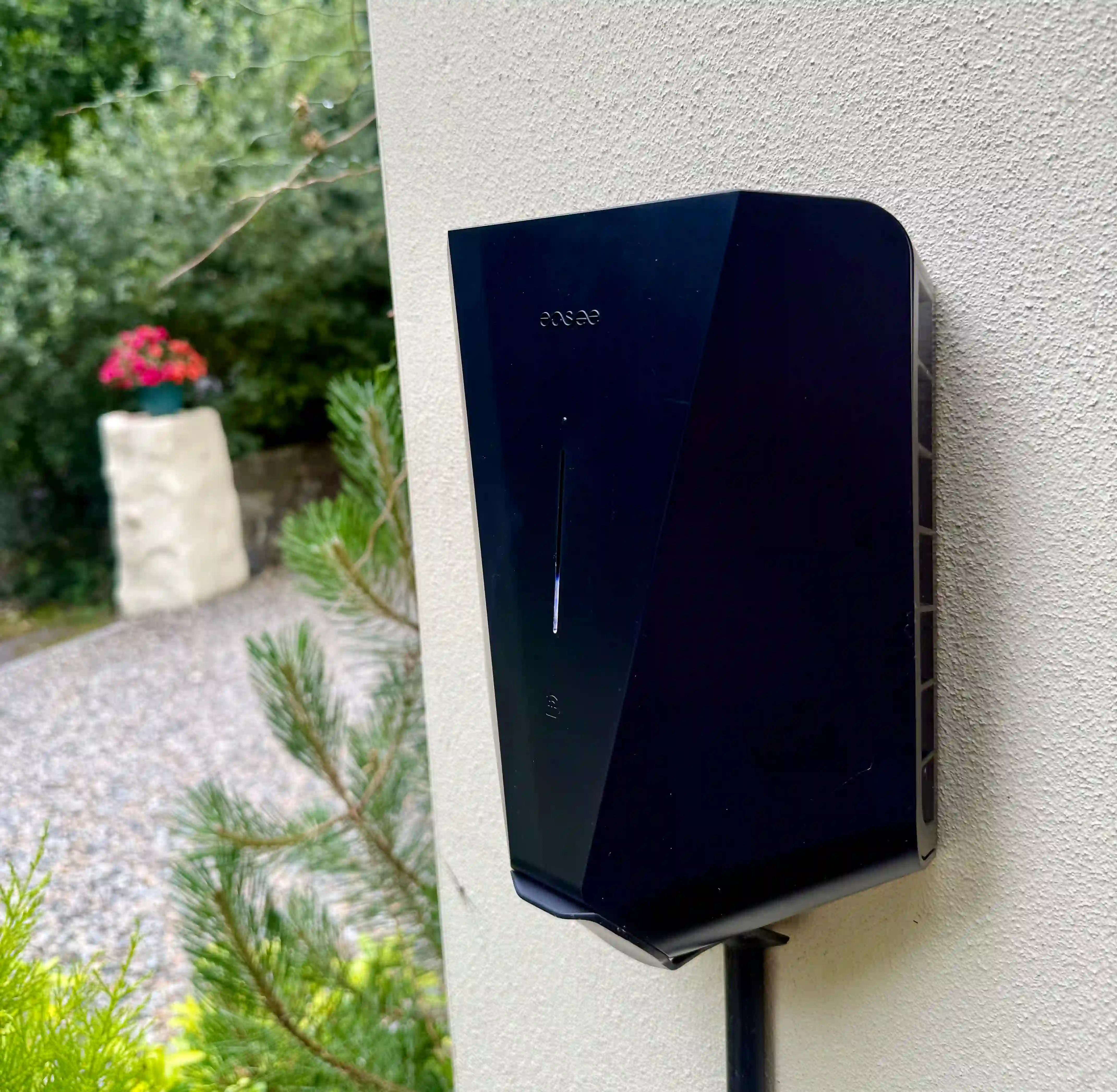
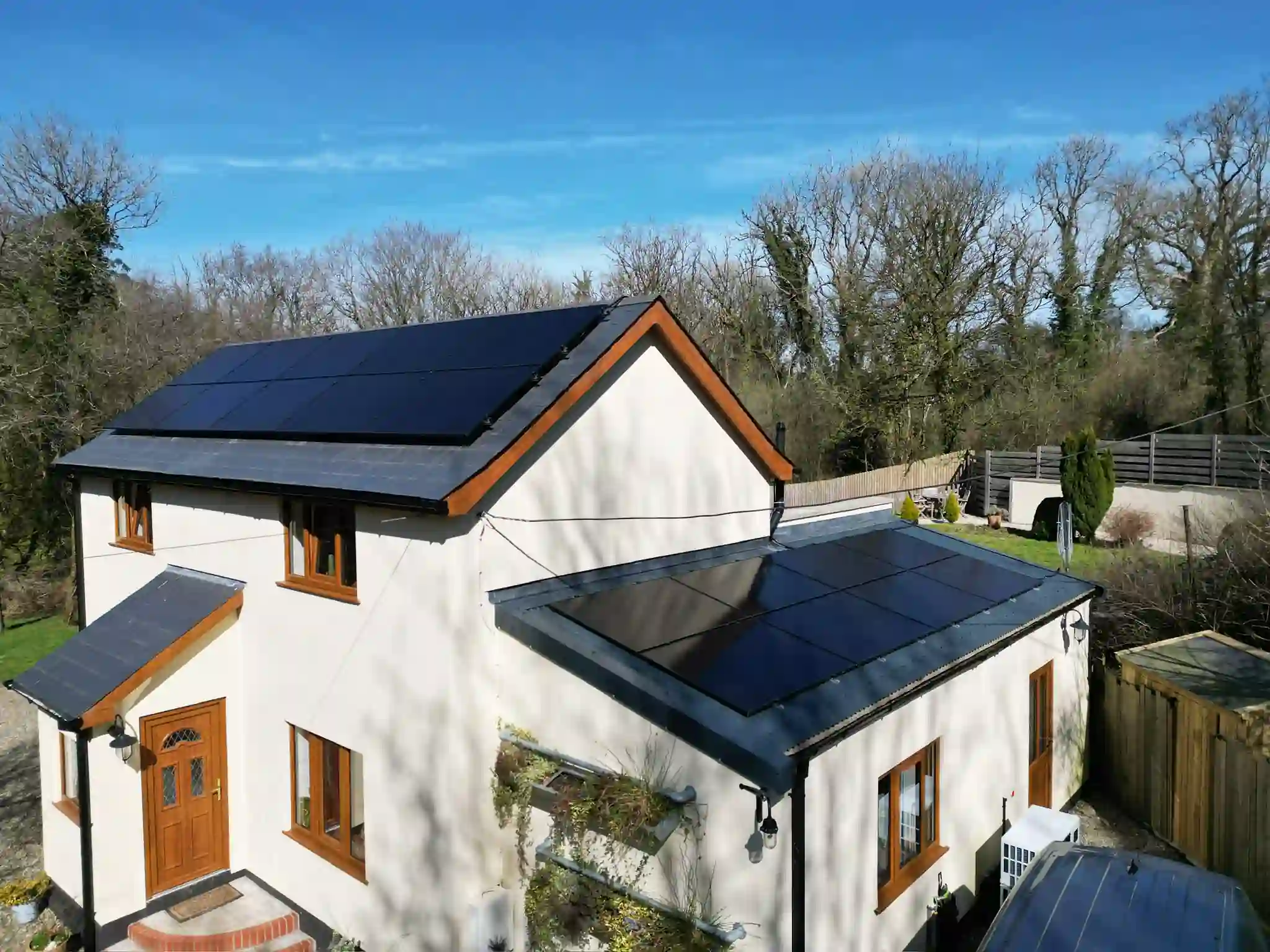
Add an EV to a Pembrokeshire house and the family load curve changes overnight. Pre-EV: 8–12 kWh/day with a small evening peak. Post-EV: 22–35 kWh/day with a 7 kW spike whenever the car plugs in. If your solar and battery aren't designed around that spike — and around the 80 A house fuse — you'll either trip out, charge from the grid at full rate, or both.
This guide covers the inverter choice, the EV charger choice, the OZEV £500 grant rules, and how to configure the whole stack to charge an EV from sunshine where possible and from cheap-rate grid where not.
Hybrid Inverter Choice
A "hybrid" inverter handles solar and battery on the same DC bus, exporting surplus AC to your home and grid. For Pembrokeshire EV homes the two we install most are:
Fox ESS H1 G2 (3.7–6.0 kW single-phase hybrid)
- • Pairs with EP5 / EP11 / EQ batteries
- • 95.5% Euro efficiency
- • Built-in CT clamp for export limiting
- • MQTT/Modbus open API — works with most EV chargers
- • 12-year warranty when installed by an MCS contractor
Sigenergy SigenStor 5/8/10 kW
- • All-in-one with battery and inverter in one cabinet
- • Native EV charger module (SigenChargers V2X)
- • Native Octopus tariff API
- • 96.5% Euro efficiency
- • 10-year warranty (15 with annual service)
OZEV-Approved Chargers We Install
The OZEV EV Chargepoint Grant offers up to £500 per socket toward the supply and installation of a chargepoint for renters, flat owner-occupiers and residential landlords (current rules from 1 April 2026). It does not cover house owner-occupiers with off-street parking — the EVHS closed to that group in April 2022 — but the smart-charging requirements still drive our equipment choice.
| Charger | Power | Solar diversion | Tariff API |
|---|---|---|---|
| Zappi v2.1 | 7.4 kW (single phase) | Yes — Eco+ mode | Octopus, ioBroker |
| Hypervolt Home 3 Pro | 7.4 kW | Yes — solar boost | Octopus, Tesla |
| Ohme Home Pro | 7.4 kW | Limited — schedule/tariff-led | Native Octopus |
| SigenChargers (with SigenStor) | 7.4 / 22 kW | Yes — via SigenStor energy management | Native |
Three Charging Strategies
1. Solar-only ("Eco+")
Charger only delivers what's coming from the panels. Free miles. In Pembrokeshire summer this can add 60–100 miles a day to a typical EV; in December it might be 5–10 miles. Best paired with an EV that's parked during daytime.
2. Off-peak forced ("Octopus Go schedule")
Charger draws full 7.4 kW between 00:30–05:30 at ~8.5p/kWh (placeholder rate checked 11 Aug 2026 — verify live at octopus.energy before relying on it). Adds approximately 150 miles overnight; at 280 Wh/mile that works out to around 3.5p/mile at this rate. Best for daily commuters with predictable mileage.
3. Hybrid blend (recommended)
Daytime solar diversion + top-up overnight off-peak. Modelled for a typical commuter profile, a Pembrokeshire family can cover 75–85% of annual EV miles below 5 p/mile.
DNO Notification and Load Balancing
National Grid Electricity Distribution (NGED, formerly Western Power Distribution) requires a G98 or G99 generation notification for the solar + battery export interface — G98 for installs ≤16 A per phase, G99 above that. The EV charger is notified separately as a load: most domestic 7.4 kW chargers go through the chargepoint connect-and-notify route, with ENA G100 / EREC G87 considerations applying to higher-power or multi-charger installs. Most Pembrokeshire properties have 100 A single-phase service heads, but older rural properties on long spurs may have 60–80 A — and that's a real bottleneck.
Load-balancing options
- • CT-clamp throttle: Zappi/Hypervolt drop EV charge rate when total household current approaches the fuse limit.
- • Inverter-led: SigenStor coordinates EV charge against battery export to keep the main fuse safe.
- • Three-phase upgrade: Worth considering for new-build farmhouses or properties with ASHP + EV + workshop.
Worked Example — 6 kW Solar + 10 kWh Battery + 7.4 kW Charger
Pembrokeshire family with 12,000 EV miles/year
- • EV consumption: 12,000 mi × 0.27 kWh/mi = 3,240 kWh/year
- • Solar-diverted (Apr–Oct): ~1,150 kWh @ 0 p
- • Battery surplus to EV: ~600 kWh @ 0 p (effectively)
- • Off-peak top-up: 1,490 kWh × 8.5p = £127 (Octopus Go placeholder rate checked 11 Aug 2026 — verify live at publish)
- • Equivalent fuel cost (petrol equivalent): £1,800+/yr
- • Total EV running cost: ~£127/yr (~4p/mile blended, at the placeholder Go rate)
Pembrokeshire-specific notes
- • If you have an ASHP and EV, prioritise battery sizing — 10 kWh is the sensible minimum.
- • Solfit in-roof solar (National Park) typically gives 2–4% lower yield than on-roof due to reduced rear ventilation, meaning slightly fewer free EV miles.
- • Tethered chargers are simpler in coastal weather — untethered cables exposed to salt corrode fast.
Wiring Topology: Where Things Sit on the Wall
A modern hybrid solar+battery+EV install in Pembrokeshire involves more components than most consumer units were designed for. The wiring topology determines whether you can run whole-home backup, dynamic load balancing and solar-diverted EV charging — or whether you're stuck with each device working in isolation.
A. Hybrid inverter on its own consumer-unit tail
PV strings into the hybrid inverter, battery on the DC bus, AC out into a dedicated 32 A circuit on the consumer unit. CT clamp on the meter tails for grid-import sensing. Standard install.
B. EV charger with own CT clamp + load-balance to inverter
EV charger (e.g. Zappi, Hypervolt, Ohme) reads the inverter's export figure via CT clamp on the inverter output, modulates charging to surplus solar. No common bus needed.
C. Sigenergy SigenStor + AC integration with EV charger
Sigenergy's stack integrates the EV charger module on the same hybrid bus — single app for solar, battery, EV. Cleanest topology for new builds, but commits you to one vendor across the whole stack.
D. Whole-home EPS topology (Fox ESS EP-Master)
Hybrid inverter pairs with EP-Master ATS that sits between meter tails and consumer unit. On grid loss, the entire house re-energises from battery + PV. EV charger gets a dedicated EPS-aware circuit so it can throttle to load.
Solar-Diverted EV Charging: Real Numbers
The theoretical case for solar-diverted EV charging is compelling — fill the car for free with surplus PV. The reality in Pembrokeshire is more nuanced because peak solar windows don't always overlap with when the car is plugged in.
| Scenario | PV size | Battery | EV miles/year | % solar-charged | Saving vs Octopus Go |
|---|---|---|---|---|---|
| Retired commuter | 4 kWp | 5 kWh | 5,000 | 62% | £140/yr |
| Family WFH | 6 kWp | 10 kWh | 10,000 | 48% | £260/yr |
| Commuter with home charging | 5 kWp | 10 kWh | 12,000 | 22% | £60/yr (mostly Go) |
| High-mileage rural | 8 kWp | 10 kWh | 18,000 | 31% | £140/yr |
Savings vs charging exclusively at Octopus Go off-peak rate. Includes export-credit foregone.
V2X Readiness in Pembrokeshire
Vehicle-to-Grid (V2G) and Vehicle-to-Home (V2H) are emerging as practical options for compatible cars (Nissan LEAF, MG ZS EV, several Kia/Hyundai models, with a growing list of CCS-capable cars adding V2X support). The hardware story is settling — the question is whether the home wiring is ready.
Future-proofing checklist
- Run a 6 mm² SWA cable to the EV charge point even if you're installing a 7 kW unit today — supports up to 22 kW V2X later.
- Specify a hybrid inverter with bi-directional export support (Sigenergy's roadmap; Fox ESS EP-series has firmware-update path).
- Consumer unit with at least 2 spare ways for V2X relay + isolator.
- EV charger pedestal sized for a future bi-directional unit (deeper backplate, extra trunking).
Three-Phase Upgrades for Pembrokeshire Smallholdings
Larger arrays (8+ kWp) and 22 kW EV chargers benefit from three-phase supply. About 12% of Pembrokeshire smallholdings are already three-phase from agricultural use; the rest are single-phase 100 A. Upgrading involves National Grid's network connection process and adds 8–14 weeks to a project.
When three-phase pays back
- PV array greater than ~3.68 kW on single phase (G98 16 A/phase limit) or 11.04 kW across three phases
- 22 kW EV charger required (e.g. fleet vehicle)
- Multiple heat pumps (e.g. main house + annex/holiday let)
- Existing single-phase service-head at capacity
Cost expectations
- £3,500–£8,000 for a service-head upgrade (no civils)
- £8,000–£20,000+ where new cable trench is needed
- NGED (formerly Western Power Distribution) lead time: 8–14 weeks
- ENA G99 application replaces G98 for arrays over 16 A/phase
Hybrid System FAQ
Do I need MCS for the EV charger?
No — EV chargers don't fall under MCS. They need a NICEIC or NAPIT-registered electrician for installation. The OZEV EV Chargepoint Grant requires an OZEV-approved installer (most major installers qualify), an OZEV-approved chargepoint and a smart-charging compliant model.
Which hybrid inverter for a Pembrokeshire smallholding?
Single-phase: Fox ESS H1 G2 6.0 kW hybrid or Sigenergy SigenStor 8 kW. Three-phase: Fox ESS H3 10/15 kW. For AC-coupled retrofits onto existing solar, the Fox ESS AC1 G2 is the appropriate choice. Sigenergy's modular EI/EC stack is best for staged-growth installs (start at 5 kWh battery, expand to 30 kWh over time).
Can I add an EV charger to an existing solar+battery system?
Yes — most modern EV chargers (Zappi, Hypervolt, Ohme) read CT-clamp signals from the inverter and modulate to solar surplus. The integration is plug-and-play within 1–2 hours of electrical work, plus charger installation time.
What about smart-charge cybersecurity?
Under the Smart Charge Point Regulations (in force since 30 June 2022), domestic and workplace chargers sold in Great Britain must meet PAS 1878 / 1879 cybersecurity standards. We commission with default credentials changed and firmware updated. The CT-clamp link to the inverter is local-network-only — no cloud dependency for solar matching.
What's the OZEV EV Chargepoint Grant covering?
The EV Chargepoint Grant covers up to £500 per socket toward the install cost for renters, flat owner-occupiers and residential landlords (rules from 1 April 2026; residential landlord grant runs to 31 March 2027). House owner-occupiers no longer qualify — the EVHS closed to that group in April 2022 — but are served by the broader Energy Saving Trust EV grant for Wales.
Plan a Solar + Battery + EV System
We design and install the whole stack — Fox ESS or Sigenergy hybrid inverter, battery, EV charger and the DNO paperwork — in one visit.
Larger solar + battery packages may be around £10,200 or £11,000 as indicative guide examples, depending on system size and specification. All prices are indicative guide prices only (inc 0% VAT). RFW prices strictly on a per-job basis following a full site survey and bespoke design.