

Ground Mount Solar for Pembrokeshire Farms
Pembrokeshire's livestock and arable farms are some of the best ground-mount sites in Wales — high irradiation, plenty of land, and serious daytime electrical demand. Here's how we specify 50–200 kWp arrays with Solarport racking and JA Solar bifacial modules.
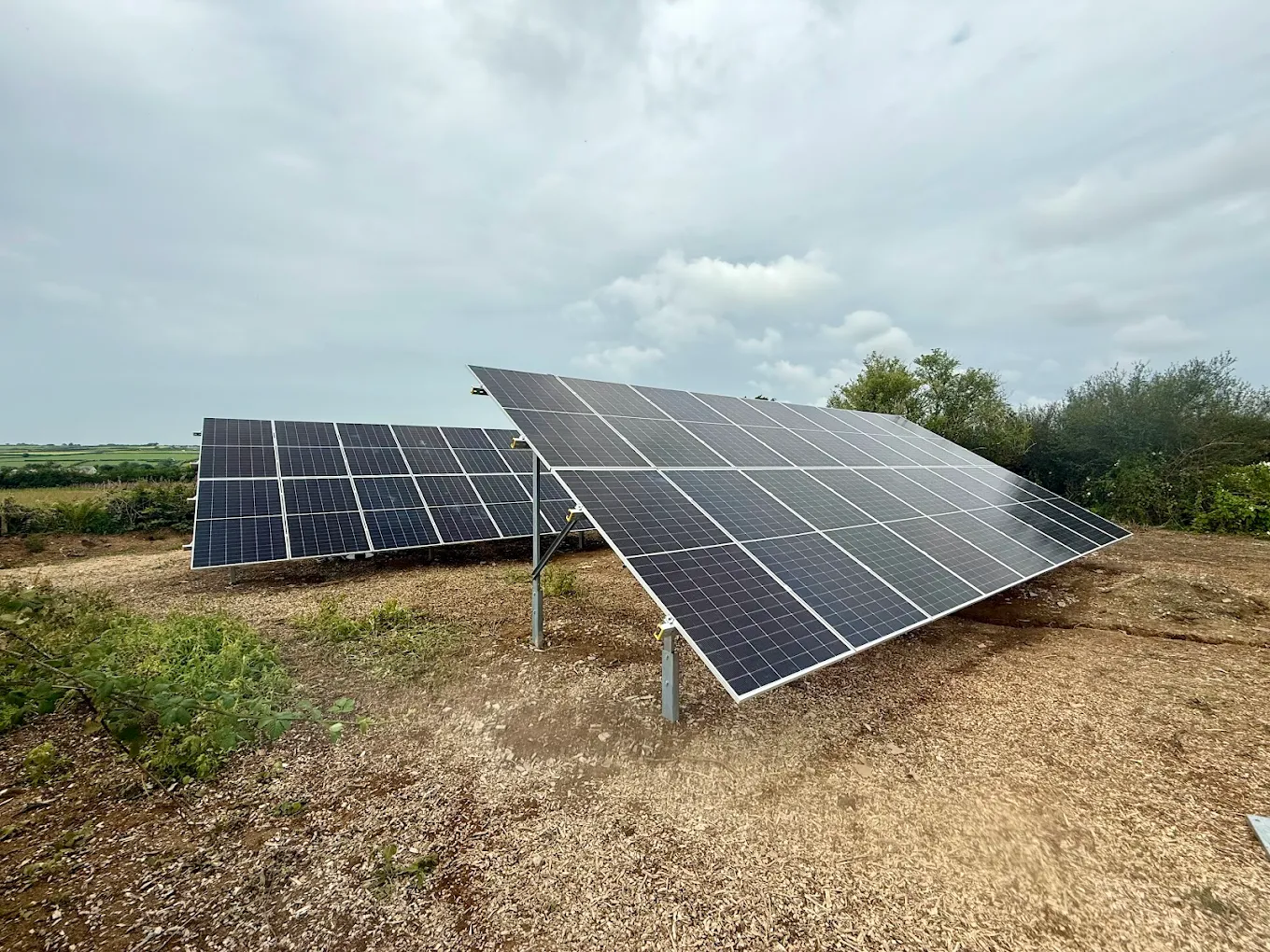
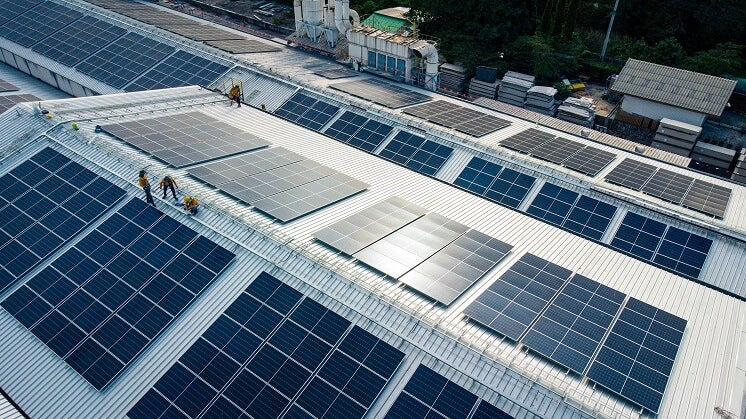
Roof-mount solar tops out around 25 kWp on most Pembrokeshire farm buildings — limited by roof area, age and structural capacity. For dairy parlours, grain stores and pumping stations that consume 80,000+ kWh a year, ground-mount is the only sensible answer.
We work with Solarport's modular system because it's purpose-built for UK farms: galvanised steel, pile-driven or ground-screw foundations as standard (concrete pads only where bedrock requires it), 25-year structural warranty, and it can be relocated if field-use changes. Paired with JA Solar's bifacial modules, ground-mount on grass yields ~6% more than the equivalent rooftop install.
When Ground Mount Makes Sense
Strong fit
- • Daytime load over 30 kW peak (parlours, grain dryers, refrigeration)
- • Spare south or south-west facing field
- • Good DNO connection (3-phase ≥ 100 kVA)
- • 5+ year tenancy / freehold
- • Agricultural buildings outside National Park
Look at roof first
- • Daytime load under 25 kW peak
- • Recently re-clad steel roofs (≤25 yr remaining life)
- • Inside National Park boundary (planning very hard)
- • Shared/short-term tenancy
Solarport Modular Racking
Solarport's UK-manufactured racking is what we install almost exclusively for farms. It's a fully galvanised, pile-driven steel structure designed for British soil and wind loadings.
Solarport — Spec Snapshot
- • Material: S350GD+Z hot-dip galvanised steel
- • Foundation: Pile-driven or ground-screw posts (concrete only on bedrock)
- • Standard tilt: 20° / 25° / 30°
- • Pile depth: 1.6–2.4 m depending on soil
- • Compatible with bifacial: Yes (rear gain modelled)
- • Wind rating: Eurocode EN 1991-1-4 Zone 5
- • Snow rating: 1.5 kN/m²
- • Structural warranty: 25 years
- • Modular layout: 8, 12, 20-panel tables — scalable
- • Sheep grazing compatible
Module Choice — JA Solar Bifacial
On grass with a Solarport pile-driven structure, bifacial modules deliver 5–8% rear-side gain — essentially free production. JA Solar's 470 W TOPCon bifacial is our default for farm ground-mounts:
| Spec | JA Solar JAM54D42 470 W bifacial |
|---|---|
| Cell type | N-type TOPCon, half-cell |
| Bifaciality | Up to 80% |
| Front efficiency | 21.8% |
| Rear gain on grass | +6–8% |
| Power tolerance | 0/+5 W |
| Product warranty | 25 years |
| Linear performance warranty | 87.4% after 30 years (warranty floor; source: JA Solar JAM54D42 datasheet) |
Planning, DNO and Permitted Development
Wales has its own planning regime. The Town and Country Planning (General Permitted Development) Order applies in modified form, and for freestanding ground-mount solar on agricultural land in Wales, full planning permission is the default. The English 50 kWp permitted-development route does not apply.
Permitted development (PD) in Wales — narrow scope
- • A single freestanding standalone ground array of ≤9 m² / ≤4 m high / ≥5 m from any boundary is PD in Wales — but only for the first such array, and not on listed buildings or their curtilage
- • Farm-scale ground-mount arrays (well above 9 m²) need full planning permission — there is no equivalent to the English 50 kWp PD route in Wales
- • Roof-mounted solar on agricultural buildings has only narrow PD scope; most farm-scale arrays go through a full application
- • PD is further restricted inside the Pembrokeshire Coast National Park, conservation areas, and for Article 4 direction areas — always confirm scope with Pembrokeshire County Council planning before assuming PD
Full planning application (typical farm route)
- • Pembrokeshire County Council fee + LVIA + ecology survey
- • 8–13 weeks determination period
- • Glint and glare assessment if near highway/airfield
- • Heritage report if listed buildings nearby
- • WG TAN 8 (Renewable Energy) and Future Wales policy support renewables on poorer land (ALC 3b/4)
DNO (NGED — formerly Western Power Distribution)
- • G99 application above 16 A per phase
- • Connection capacity check — budgetary ~£200–£600 fee (confirmed at application; G99 applications vary)
- • ANM (active network management) on constrained substations is increasingly common
- • Allow 8–16 weeks for offer + acceptance
Worked Example — 100 kWp Dairy Farm Near Crymych
Dairy with 80,000 kWh/yr daytime load
Illustrative year-1 benefit calculation at the Ofgem cap for July–September 2026(26.11p/kWh — resets quarterly; verify at publish). Annual yield: ~104,000 kWh (100 kWp × 1,040 kWh/kWp incl. ~6% bifacial gain on grass, PVGIS SA postcodes — record PVGIS query date at publish). With 65% self-consumption: 67,600 kWh × 26.11p = £17,650 import saving; 36,400 kWh export × 12p (conservative lower bound of ~12–15p/kWh flat SEG tariffs, checked Aug 2026) = £4,368 export income. Total illustrative year-1 benefit: £22,018. Capex from example turnkey cost above (£112,300). All £ figures are illustrative — recalculate if the cap changes before publish.
Pembrokeshire farm-specific watch-outs
- • Salt-laden sites near coast: specify hot-dip galvanising to BS EN ISO 1461 with 85+ µm coating thickness.
- • Sheep grazing: raises the bottom edge to 0.8 m clearance — Solarport accommodates this without yield penalty.
- • BMV land: WG TAN 8 strongly discourages BMV for solar — use poorer grazing land where possible.
- • Rural connection charging: Some Pembrokeshire substations are constrained — DNO offer is worth getting before committing to size.
Foundation and Soil Considerations
Pembrokeshire's geology ranges from heavy boulder clay across the Preseli foothills to thin soil over Carboniferous limestone in the south. Solarport's modular system is rated for both ground-screw and concrete pad foundations — the right choice depends on a soil test, not on what's quickest to install.
| Foundation | Best for | Install rate | Cost (per panel-row) | Reversibility |
|---|---|---|---|---|
| Ground screws (1.6 m) | Good clay, no rock | ~40/day | £190 | Full removal possible |
| Driven posts | Deep loamy soil | ~60/day | £140 | Possible |
| Concrete pads | Limestone bedrock | ~15/day | £280 | Pads remain |
| Ballast frames | Listed land, top-soil only | ~25/day | £320 | 100% reversible |
Typical figures from our installs; site-specific conditions will vary — confirm with your installer before budgeting.
Pre-build site investigation
We always commission a 3-borehole soil test (~£800) before final foundation specification. The test reveals: bedrock depth, water table, soil bearing capacity, and presence of any archaeology. PCC's archaeology team flags areas of historic interest that may need a watching brief during groundworks.
For sites in or near the Preseli Hills, a CADW pre-application enquiry is essential — there are scheduled monuments scattered across the landscape that aren't always on the headline maps.
Sheep Grazing Co-Design (Solar Grazing)
Pembrokeshire farms increasingly want their solar fields to remain productive grazing land. Properly designed, an array can host 3–5 ewes per acre under and around the panels — the panels actually improve forage productivity in dry summers (we're seeing this measured at +12–18% on Pembrokeshire trials).
Design rules for sheep co-grazing
- Module bottom edge minimum 0.85 m above ground (Solarport's standard)
- String/cable management above 1.2 m or buried in conduit
- No sharp edges on racking; 1.5 mm chamfer minimum
- Inverter / DC combiner enclosures off the ground in lockable cabinets
- Perimeter fence height suitable for sheep but with badger / hare gaps
Subsidy and policy points
- Welsh Government Sustainable Farming Scheme allows BPS/SFS payments under solar with sheep
- NRW abstraction-licence implications: minimal for grazing, none for the panels
- BMV (Best and Most Versatile) land — ALC Grade 1/2 land is restricted; Grade 3b/4 is the typical solar candidate
- 40-year decommissioning bond is standard, ringfenced via legal agreement
DNO Connection Process for Farm Arrays
For arrays exporting more than 16 A per phase, you need a G99 application to National Grid Electricity Distribution (NGED, formerly Western Power Distribution). The process determines connection cost — sometimes the deciding factor on whether a farm project is viable.
Stage 1 — Budget estimate (free, 4 weeks)
Scoping enquiry establishes whether your local network can absorb the export at your proposed size. Useful for sizing the project sensibly — sometimes 199 kWp can connect cheaply but 250 kWp requires £80k of network reinforcement.
Stage 2 — Formal G99 application (£700–£1,500, 8 weeks)
Detailed network study with a binding offer for connection cost and timeline. The offer is valid for 90 days; you accept by paying the connection fee.
Stage 3 — Reinforcement works (3–18 months)
If reinforcement is needed (transformer upgrade, switch-fuse replacement, new pole-mounted reclosers), this is the critical-path item. Most farm arrays in Pembrokeshire connect at 11 kV with a pole-mounted transformer, install within 6 months.
Stage 4 — Commissioning + witness test
DNO engineer attends commissioning, witnesses G99 protection settings test, signs off connection. Export limit set in inverter firmware.
Worked Example: 100 kWp Farm Array, North Pembrokeshire
Mixed beef/sheep farm near Eglwyswrw, 1.4 acre south-facing field, ALC Grade 4. Owner wanted to offset the parlour and grain-drying loads plus export the surplus.
| System size | 99.6 kWp (220 × 460 W Aiko Neostar 2P bifacial) |
| Mounting | Solarport modular ground-mount, ground-screw foundations, 25° tilt |
| Inverter | 2 × Fox ESS T-Series 50 kW string inverters |
| Annual yield | 95,000 kWh (~954 kWh/kWp, includes ~6% bifacial gain on grass albedo) |
| Self-consumption | 38% (parlour, grain drier, farmhouse) |
| Export | 62% on Smart Export Guarantee tariff (12p/kWh — lower bound of ~12–15p/kWh flat SEG tariffs, checked Aug 2026) |
| Capex | £82,000 (turnkey including DNO connection) |
| Illustrative year-1 benefit | £9,426 import saving (36,100 kWh × 26.11p) + £7,068 export income (58,900 kWh × 12p) = £16,494Illustrative at Ofgem cap 26.11p/kWh (July–September 2026, revised quarterly) and SEG 12p/kWh. Verify at publish. |
| Illustrative simple payback | ~5.0 years(£82,000 capex ÷ illustrative year-1 benefit at current cap) |
Farm Solar FAQ
Do I need planning permission?
In Wales, freestanding ground-mount solar on agricultural land normally needs full planning permission. Roof-mounted PD on farm buildings is also tightly constrained, so most farm arrays — roof or ground — go through a full application. We handle that end-to-end including landscape and visual impact assessment.
Will my single farm payment be affected?
Under the Welsh SFS scheme replacing BPS, land with solar plus continued grazing remains eligible for area-based payments. Land taken out of production entirely (e.g. high-density solar without grazing) loses eligibility.
What about VAT and capital allowances?
Farm solar qualifies for the 100% Annual Investment Allowance (AIA) up to £1m, meaning the full project cost can be written off against the year's profits. VAT is reclaimable for VAT-registered farm businesses. We provide all paperwork for your accountant.
Can I add battery storage to a farm array?
Yes — increasingly common in Pembrokeshire. A 30–60 kWh commercial battery (e.g. Fox ESS C&I or Sigenergy SigenStor 50) shifts daytime generation to evening parlour-flush + dairy loads. Pays back in 4–6 years on G99-connected farms.
What's the lifespan of a farm array?
Solarport racking: 25 years structural warranty, 40+ year design life. Aiko Neostar and JA Solar modules both carry 30-year linear performance warranties. Inverters: 10–15 years (replace once over the project life). Total project life 30–40 years with one mid-life inverter refresh.
Talk to Us About a Farm Solar Project
We design, plan, install and commission farm-scale ground-mount solar across Pembrokeshire — from the feasibility study through to the DNO connection.